Daniel Morgan’s victory over the notorious Tarleton on 17th January 1781
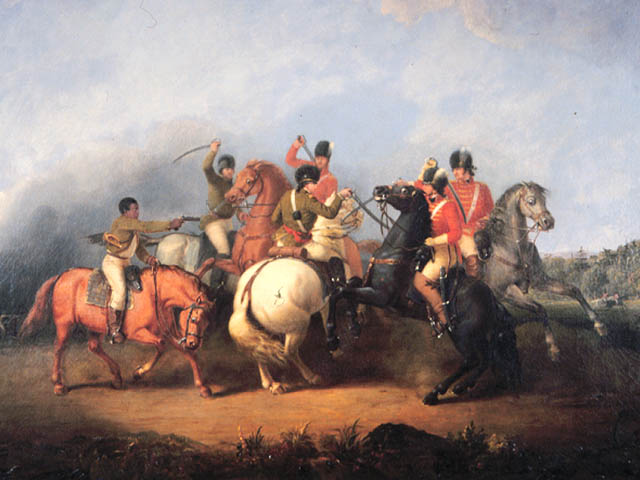
Saving the life of Colonel William Washington at the Battle of Cowpens on 17th January 1781 in the American Revolutionary War : picture by William Ranney
The previous battle of the American Revolutionary War is the Battle of King’s Mountain
The next battle of the American Revolutionary War is the Battle of Guilford Courthouse
To the American Revolutionary War index

Brigadier Daniel Morgan, American commander at the Battle of Cowpens on 17th January 1781 in the American Revolutionary War
Battle: Cowpens
War: American Revolutionary War
Date of the Battle of Cowpens: 17th January 1781
Place of the Battle of Cowpens: South Carolina on the border with North Carolina, in the United States of America
Combatants at the Battle of Cowpens: Americans against the British and loyalist Americans
Commanders at the Battle of Cowpens: The American commander was Brigadier Daniel Morgan and the British commander Lieutenant Colonel Banastre Tarleton
Size of the armies at the Battle of Cowpens: The American force comprised around 1,000 men and the British force around 1,100 men.
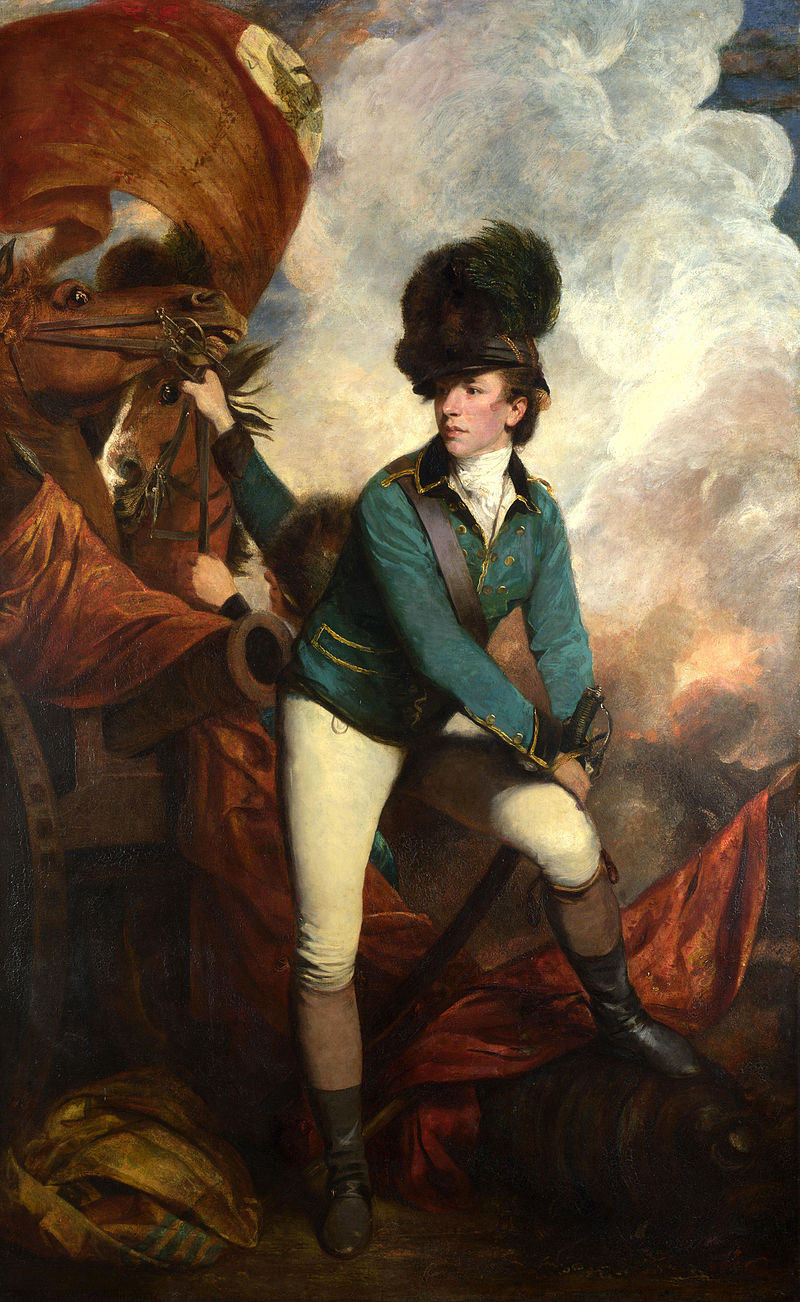
Lieutenant-Colonel Banastre Tarleton, British commander at the Battle of Cowpens on 17th January 1781 in the American Revolutionary War: picture by Joshua Reynolds
Uniforms, arms and equipment at the Battle of Cowpens: The British infantry wore red coats, with bearskin caps for grenadiers, tricorne hats for battalion companies and caps for the light infantry. The Highland Scots troops wore the kilt and feather bonnet.
The two regiments of British light dragoons serving in America, the 16th and 17th, arrived in America wearing red coats and crested leather helmets. As the war progressed, the light dragoons abandoned their red coats for green.
Tarleton’s legion wore a uniform of green and the cavalry wore light dragoon helmets.
The American troops dressed as best they could. Increasingly, as the war progressed, infantry regiments of the Continental Army mostly took to wearing blue or brown uniform coats. The American militia continued in rough clothing.
The infantry of both sides were armed with muskets. The British and German infantry carried bayonets. The Highland Scots troops carried broadswords as an additional weapon.
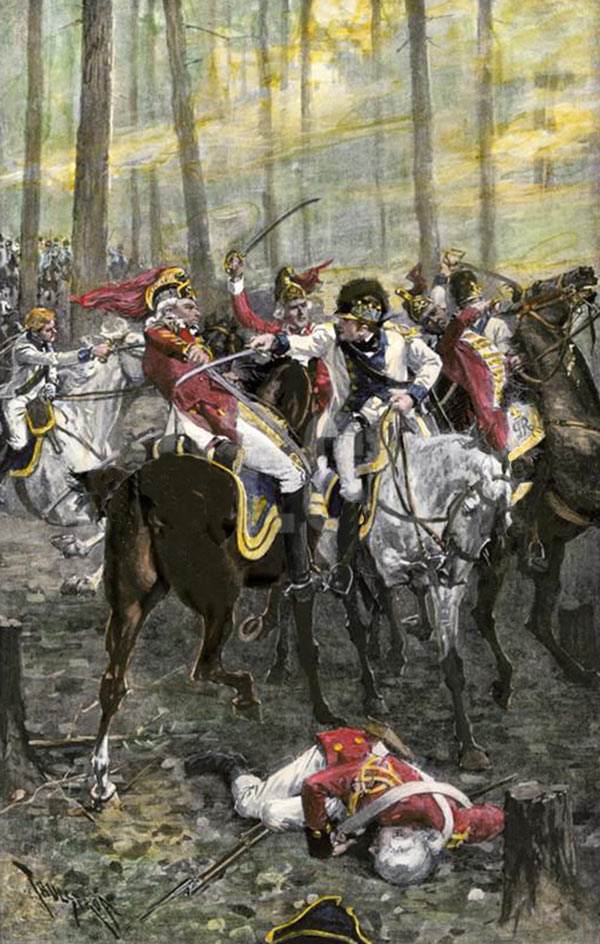
Battle of Cowpens on 17th January 1781 in the American Revolutionary War
Steuben insisted that the American Continental troops be issued with bayonets, whose use Steuben’s training dealt with, so that they could meet the British and German infantry on an equal footing in hand to hand fighting. This took time to implement in full.
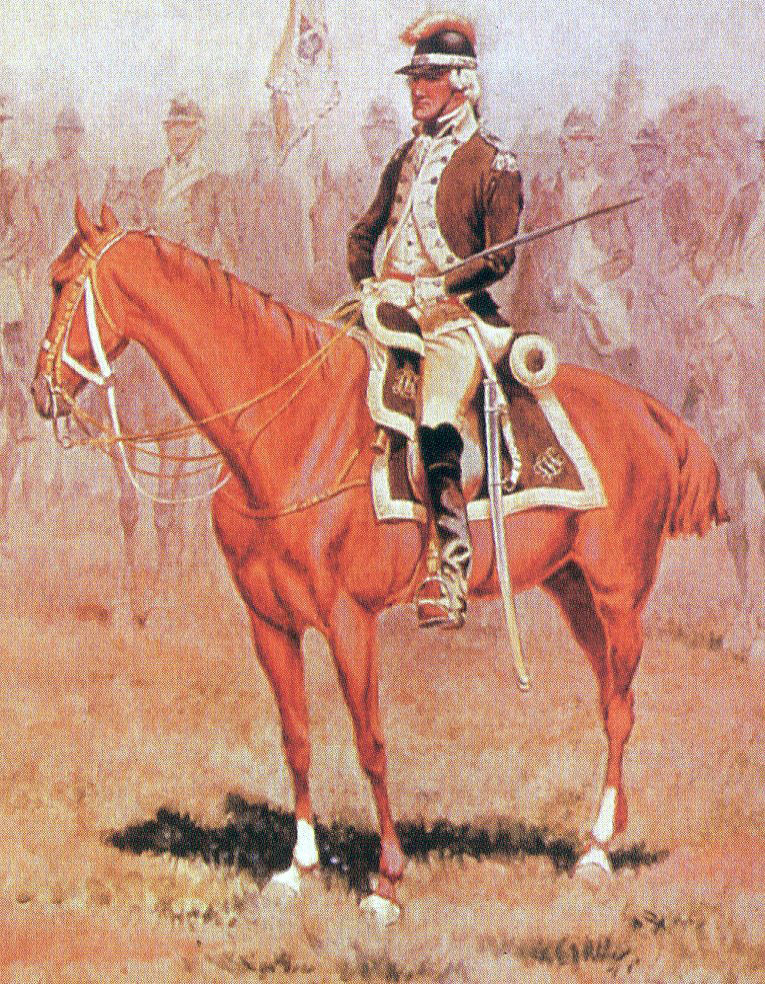
American Dragoon: Battle of Cowpens on 17th January 1781 in the American Revolutionary War

Highland Sergeant: Battle of Cowpens
Many men in the Pennsylvania and Virginia militia regiments carried rifled weapons, as did other backwoodsmen. Washington and Steuben were against the use of rifles, as they took longer to load than a smooth bore musket.
Only the British were supported by artillery.
The British fought with musket and bayonet as did the American Continental troops. Some of the militia from the back country of Virginia, the Carolinas and Georgia carried rifles and in many cases the Pennsylvania small calibre long rifle developed by the German gunsmiths of that colony. It was these riflemen who at the beginning of the battle shot down so many British officers and destroyed the proper control of the British line.
Winner of the Battle of Cowpens: The Americans, overwhelmingly.
British Regiments at the Battle of Cowpens:
17th Light Dragoons, 7th Foot (the Royal Fusiliers), a battalion of 71st Fraser’s Highlanders (disbanded after the war), Royal Artillery with two 3 pounder guns and “Tory” militia.
American Regiments at the Battle of Cowpens:
Lieutenant-Colonel William Washington’s dragoons, Maryland Continentals, Delaware Continentals, Virginia Militia, North Carolina Militia and Georgia Militia.
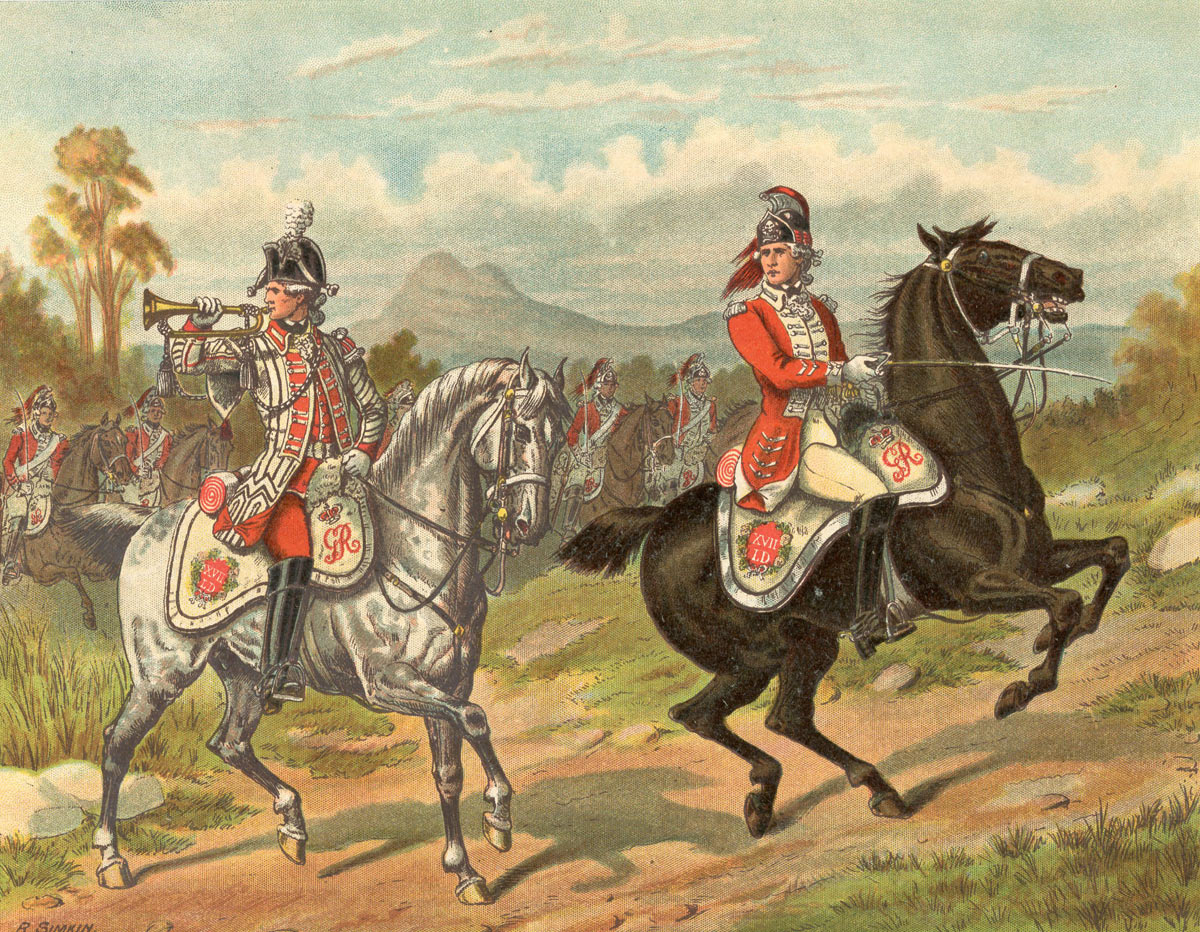
British 17th Light Dragoons: Battle of Cowpens on 17th January 1781 in the American Revolutionary War: picture by Richard Simkin
Background to the Battle of Cowpens:
The war in the southern colonies had become something of a stalemate, neither side having sufficient strength to hazard full offensive operations. The fighting was conducted by raiding columns and guerrilla activity. Both sides behaved with unrestrained ferocity.
Tarleton’s reputation, in the southern colonies, was as a ruthless and impetuous commander.
Pursued by Tarleton, Morgan determined to make a stand by the Broad River. On 16th January 1781, Morgan took up a position on two low hills in open woodland, in the expectation that Tarleton would make a headlong attack, without pausing to devise a subtler plan. Morgan was correct in his assessment of Tarleton’s likely action.
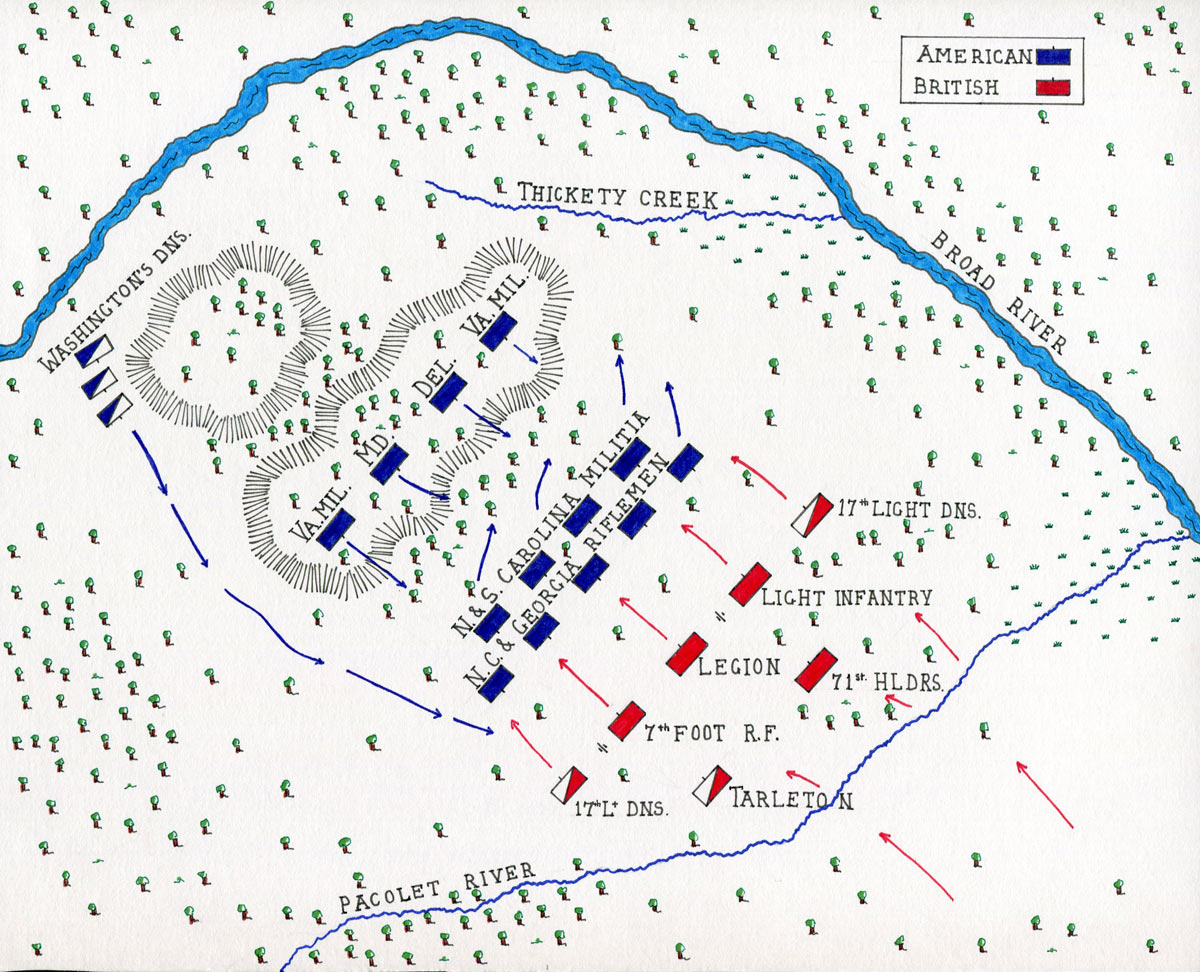
Map of the Battle of Cowpens on 17th January 1781 in the American Revolutionary War : map by John Fawkes
Account of the Battle of Cowpens:
Morgan placed his main line on the first and higher hill. Washington’s dragoons were positioned behind the hill. Morgan stationed the Georgia and North Carolina militia in front of his line, with a further screen of riflemen to their front. Morgan’s men spent the night in their positions.
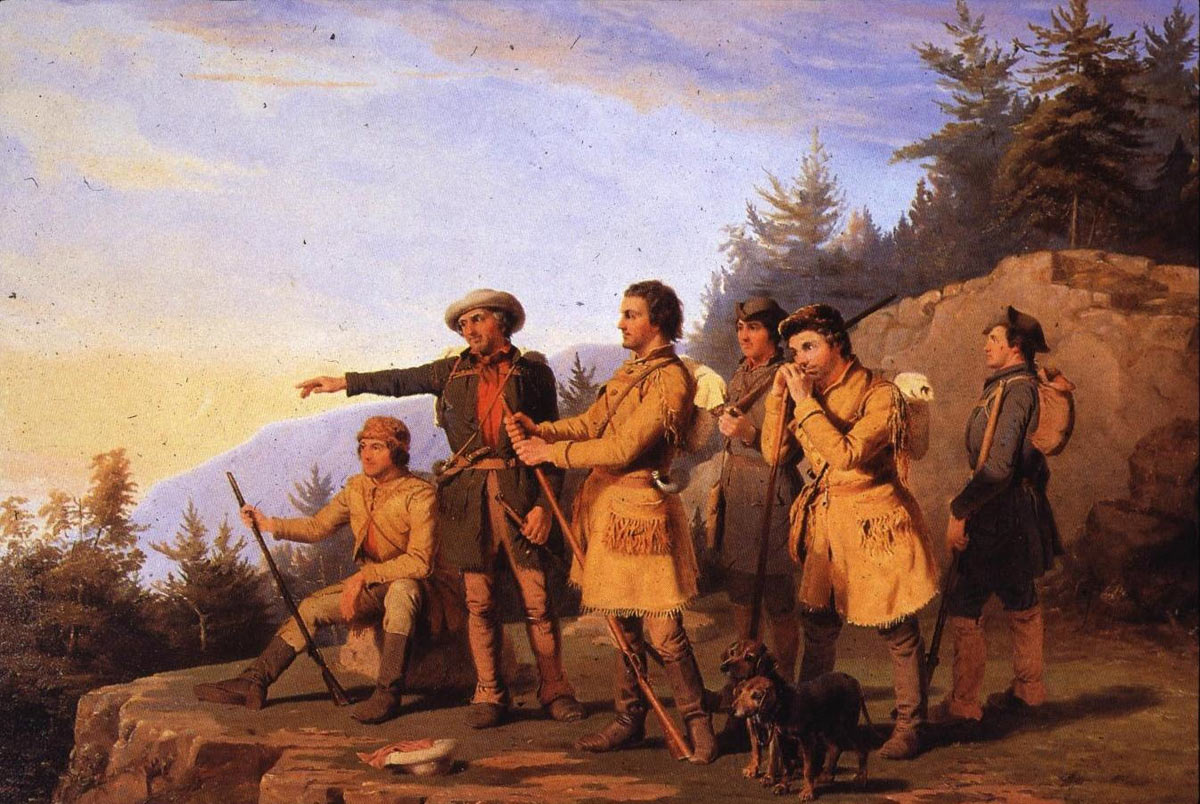
American Riflemen: Battle of Cowpens on 17th January 1781 in the American Revolutionary War: picture by William Ranney
On 17th January 1781, Tarleton marched his force onto the battlefield and attacked immediately. His first move was to send the 17th Light Dragoons to disperse the riflemen. The dragoons were driven back by accurate fire.
Tarleton formed his infantry line and began the advance; the Light Infantry on the right, the infantry of Tarleton’s Legion in the centre and the 7th Royal Fusiliers on the left. Troops of light dragoons flanked the foot. The reserve comprised the 71st Highlanders and the cavalry of Tarleton’s Legion.
Morgan’s riflemen opened fire on the British and made a point of shooting down the ‘epaulettes’ (the officers), before falling back behind the main American line.
A troop of light dragoons pursued the riflemen and were attacked and driven back by Washington’s dragoons.
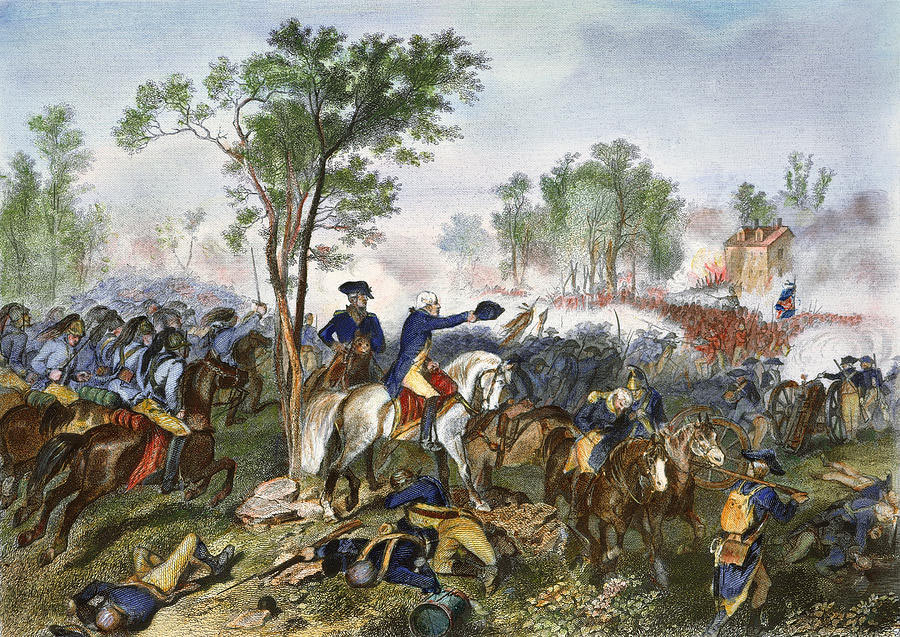
Battle of Cowpens on 17th January 1781 in the American Revolutionary War: picture by Charles Henry Granger
As the British foot attacked, the 71st Highlanders extended the line to the left, outflanking the Americans. The Americans withdrew, but in good order. The British line lost its cohesion, as it hurried to come to close quarters with the Americans, who repeatedly halted and gave fire.
Washington’s dragoons circled round behind the advancing British and again attacked, this time in the rear of the British line.
The Americans went onto the offensive and the British line, attacked in the front and the rear, collapsed. The 71st continued to fight until forced to surrender.
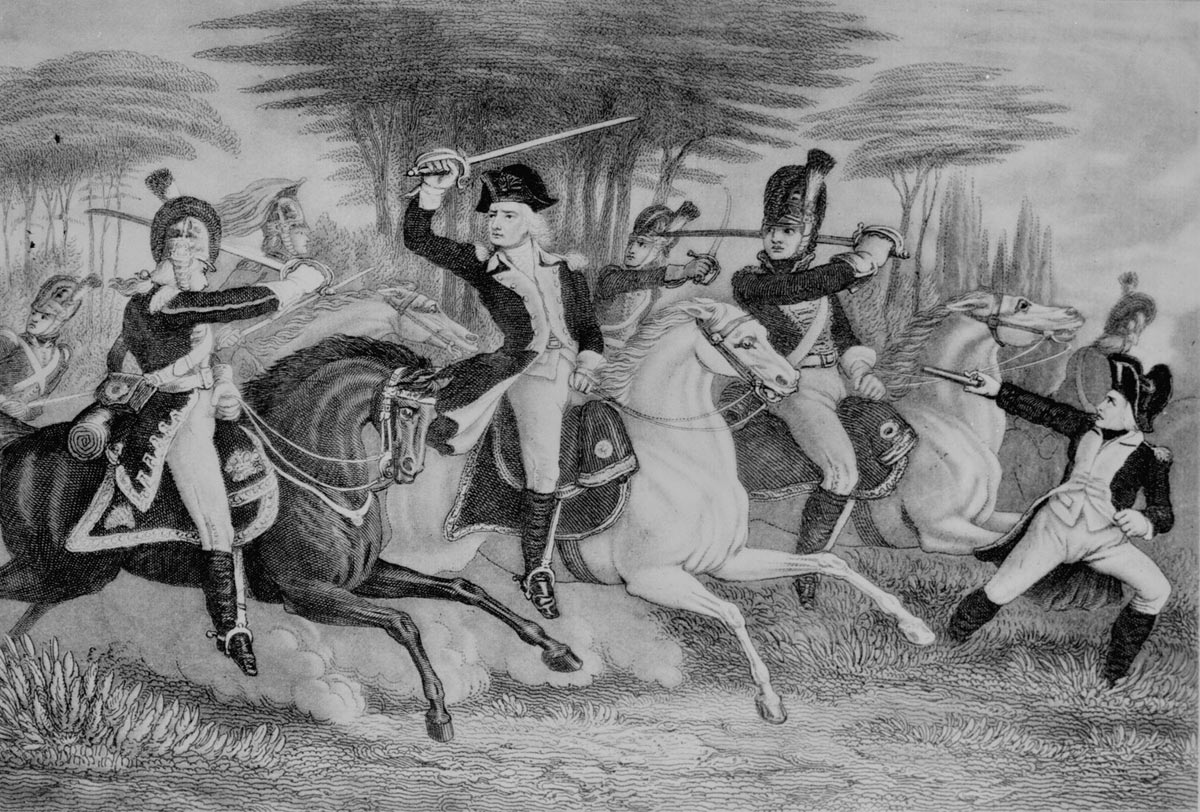
Colonel William Washington under attack during the Battle of Cowpens on 17th January 1781 in the American Revolutionary War
The Royal Artillery gunners fought on, until they were all killed or wounded.
Tarleton fled the field with the remnants of his force, the cavalry of his legion having refused to charge from the reserve.
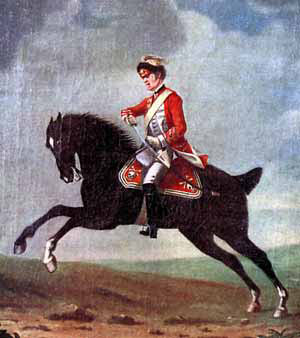
17th Light Dragoon: Battle of Cowpens on 17th January 1781 in the American Revolutionary War
Casualties at the Battle of Cowpens:
The British lost 39 officers and 60 soldiers killed. 829 were captured. 12 Americans were killed and 60 wounded. The Americans captured the British guns and baggage and the colours of the 7th Foot.
Follow-up to the Battle of Cowpens:
This small battle had an effect disproportionate to its size. As frequently seemed to be the case throughout the war, British victories achieved little in the long term, while every American victory gave encouragement to the colonies.
Traditions and anecdotes from the Battle of Cowpens:
- The area where the Battle of Cowpens was fought was used to graze cattle, hence the name.
- Tarleton, used to fighting the untrained and unreliable local militia in the southern colonies, underestimated the ability of his opponent Brigadier Morgan and the quality of his troops.
- Many of the riflemen, positioned in front of the American force, were the ‘over mountain men’ who fought so ferociously at the Battle of King’s Mountain.
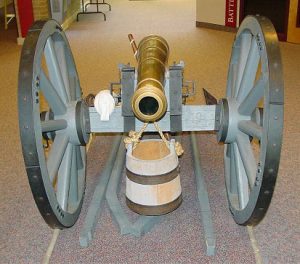
British Royal Artillery 3 pounder ‘grasshopper’ cannon: Battle of Cowpens on 17th January 1781 in the American Revolutionary War
- The Americans gave ‘Tarleton’s quarter’ to the surrendering British and Loyalist troops- a bayonet in the stomach- until restrained by their officers; an indication of the depths of ferocity to which the fighting in the Carolinas descended, substantially due to the conduct of Tarleton and his Legion.
- The British 3 pounder guns were known as ‘grasshoppers’.
- Lieutenant-Colonel William Washington, commander of the American cavalry, was second cousin to General George Washington. William Washington is shown in William Ranney’s picture (see above) being rescued from a group of British Light Dragoons by a Black American soldier at the Battle of Cowpens.
- Daniel Morgan was yet another soldier of the American Revolutionary War who cut his teeth with General Edward Braddock in 1755. Morgan was a cousin of Daniel Boone and was one of Braddock’s teamsters in the doomed campaign against Fort Duquesne.

References:
History of the British Army by Sir John Fortescue
The War of the Revolution by Christopher Ward
The American Revolution by Brendan Morrissey
The previous battle of the American Revolutionary War is the Battle of King’s Mountain
The next battle of the American Revolutionary War is the Battle of Guilford Courthouse
To the American Revolutionary War index