The hard-fought battle on 7th July 1777 in the forest south-east of Fort Ticonderoga
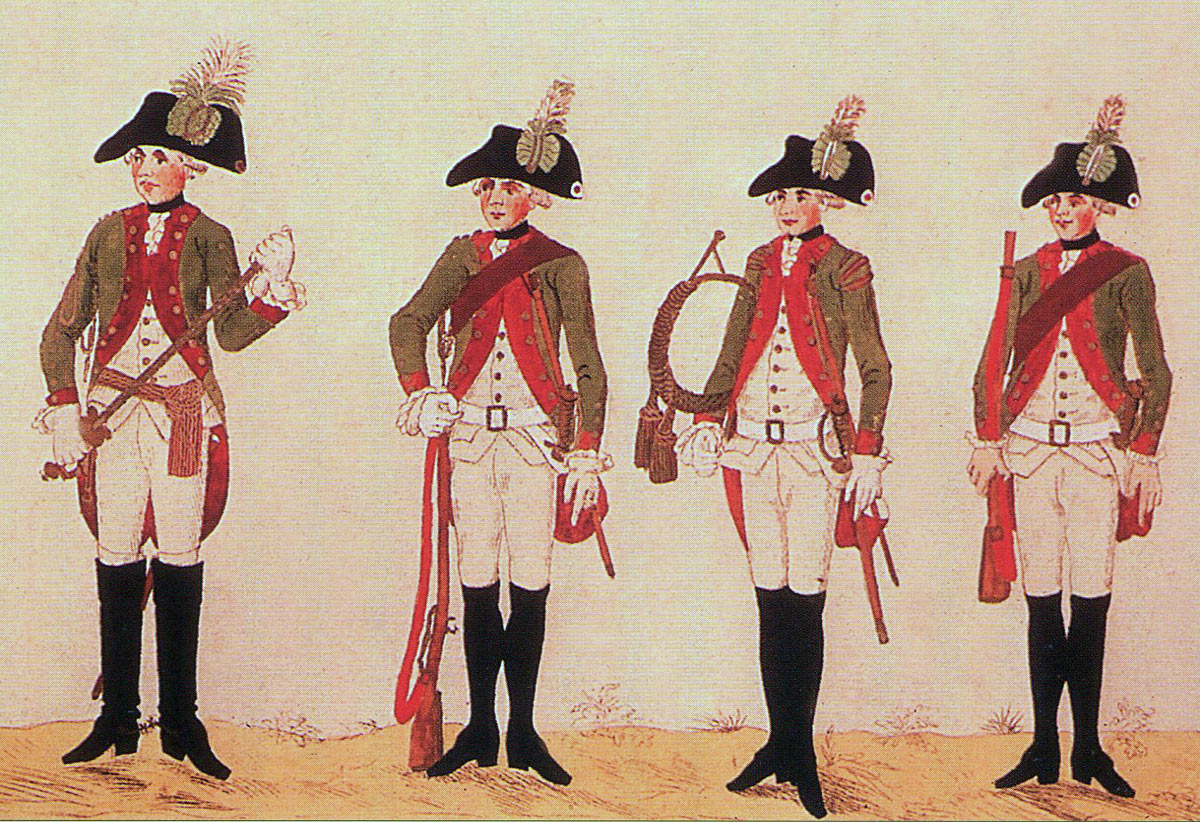
Hessian Jägers: Battle of Hubbardton on 7th July 1777 in the American Revolutionary War
The previous battle of the American Revolutionary War is the Battle of Fort Ticonderoga 1777
The next battle of the American Revolutionary War is the Battle of Bennington
To the American Revolutionary War index

Baron Riedesel: Battle of Hubbardton on 7th July 1777 in the American Revolutionary War
War: American Revolutionary War
Date of the Battle of Hubbardton: 7th July 1777.
Place of the Battle of Hubbardton: New York State on the road south east from Ticonderoga
Combatants at the Battle of Hubbardton: British and Americans
Generals at the Battle of Hubbardton: Brigadier Simon Fraser commanded the British, Baron Riedesel commanded the Germans and Colonels Francis and Warner commanded the Americans.
Size of the forces at the Battle of Hubbardton: About 1,000 British and German troops against around 1,000 Americans.
Uniforms, arms and equipment at the Battle of Hubbardton: The British wore red coats, with bearskin caps for the grenadiers, tricorne hats for the battalion companies and caps for the light infantry.
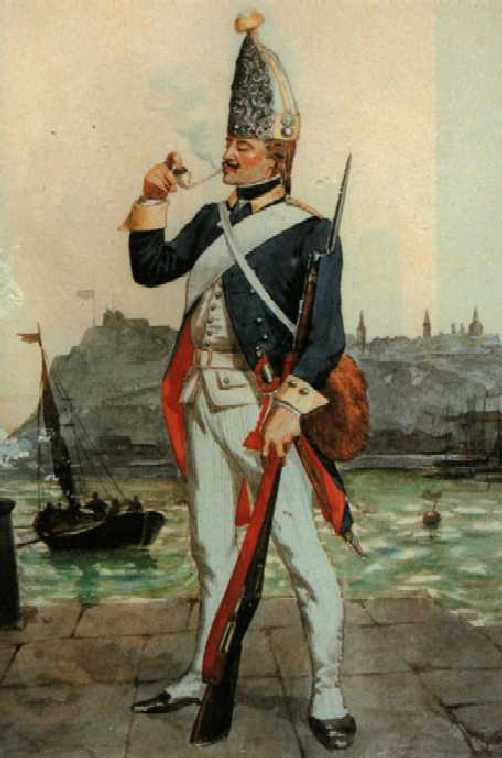
Regiment von Breymann: Battle of Hubbardton on 7th July 1777 in the American Revolutionary War
The German infantry wore blue coats and retained the Prussian style grenadier mitre cap with brass front plate.
The Americans dressed as best they could. Increasingly as the war progressed regular infantry regiments of the Continental Army wore blue uniform coats, but the militia continued in rough clothing.
The British and German troops were armed with muskets and bayonets. The Americans carried muskets, largely without bayonets. The Pennsylvania regiments and other men of the woods carried long, small calibre, rifled weapons. cannons, mostly of small calibre.
Winner of the Battle of Hubbardton: The British and German troops.
British Regiments at the Battle of Hubbardton: 24th Foot, Grenadiers and Light Infantry.
German Regiments at the Battle of Hubbardton: Riedesel’s Regiment, Breymann’s Grenadiers and Jägers.
American Regiments at the Battle of Hubbardton: Francis’ 11th Massachusetts, Hale’s 2nd New Hampshire Regiment and Warner’s Green Mountain Men from Vermont.
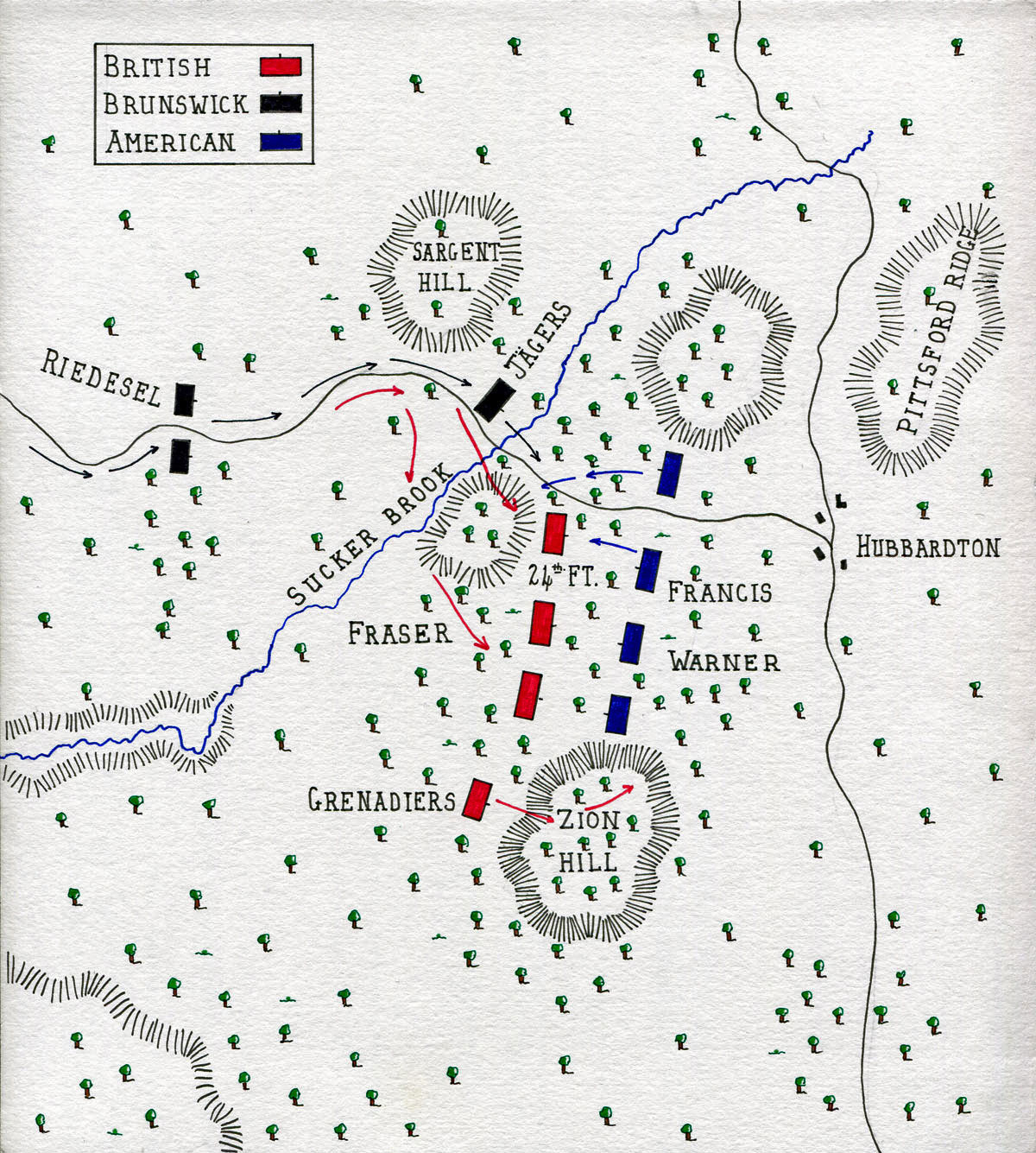
Map of the Battle of Hubbardton on 7th July 1777 in the American Revolutionary War: map by John Fawkes
Account of the Battle of Hubbardton:
Following the attack by General Burgoyne’s British army on Fort Ticonderoga, General St Clair’s troops left Fort Ticonderoga on 6th July 1777, hastening to put as much ground between themselves and the pursuing army of General Burgoyne in their retreat to the south. The weather was hot and the march along the rudimentary track through the forest was heavy going.
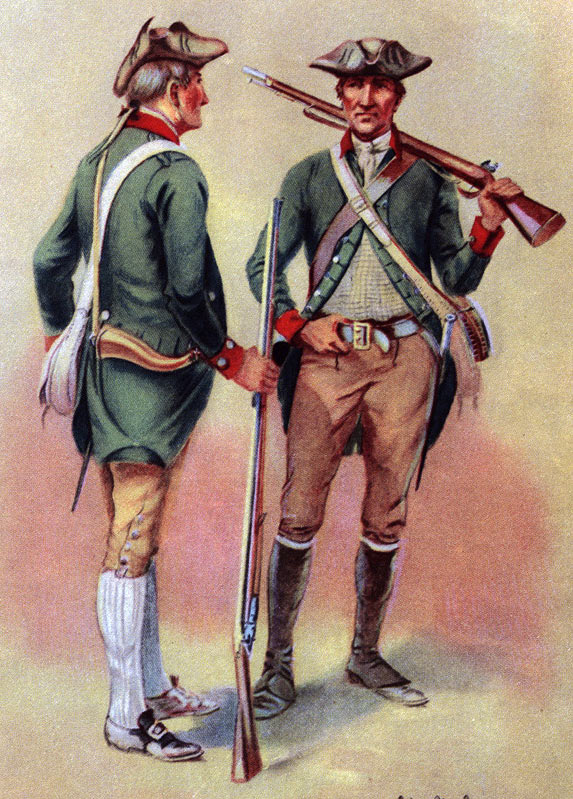
Seth Warner’s Vermont Green Mountain Boys: Battle of Hubbardton on 7th July 1777 in the American Revolutionary War: picture by Charles M. Lefferts
After 26 miles marching through the forest, the Americans reached Hubbardton, a small hamlet. St Clair marched on, leaving Colonel Seth Warner and his Green Mountain Boys at Hubbardton to await the rear-guard of Colonel Francis’ 11th Massachusetts and Hale’s 2nd New Hampshire Regiments.
Once the rear-guard reached Hubbardton, Francis and Hale decided to camp overnight to allow their men to recover from the rigours of the evacuation of Fort Ticonderoga and the long march. They assumed they had outstripped the British and German troops and failed to post a proper picket line.
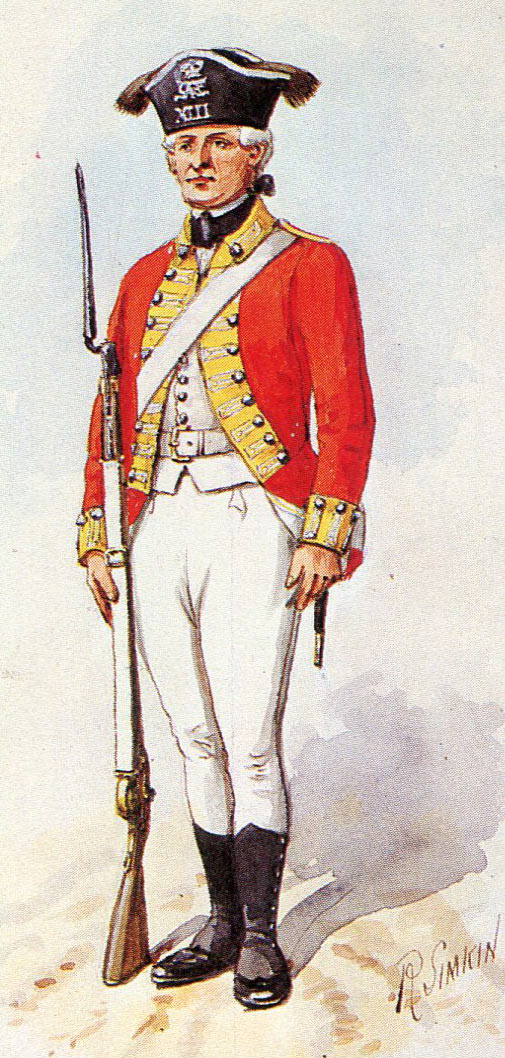
British Light Infantryman: Battle of Hubbardton on 7th July 1777 in the American Revolutionary War: picture by Richard Simkin
In fact, Brigadier Simon Fraser had pressed the pursuit and that night camped near to Hubbardton.
The British 24th Regiment, with British and Brunswick Grenadiers and Light Infantry, resumed the advance at 3am the next morning and, coming upon the Americans as they breakfasted, promptly attacked.
The first Americans to be assaulted, Hale’s New Hampshires, gave way in disorder. Warner’s and Francis’ Regiments quickly formed up and resisted strongly. The fighting was intense and Major Grant, commanding the British 24th Foot, was killed.
The Americans formed a line stretching through wooded country, with hills on each flank. Brigadier Simon Fraser sent his grenadiers to climb the hill to the American left and outflank them.
The hill was steep and the encircling move by the grenadiers took longer than expected. In the meantime, Colonel Francis advanced around Fraser’s left flank, reinforced by some of Hale’s regiment who were returning to the battlefield. Fraser, whose force was inferior in numbers to the Americans, found himself in some difficulty.
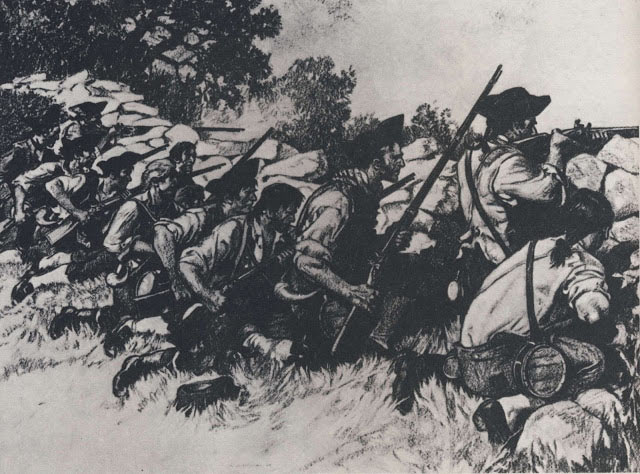
American troops at the Battle of Hubbardton on 7th July 1777 in the American Revolutionary War
The sound of the battle was heard by General St Clair, the American commander, to the south. He ordered two militia regiments to return and support Francis, but they refused.
To the north-west, the German officer, Baron Riedesel, also heard the firing and hurried up in support of Brigadier Fraser. Riedesel sent the Brunswick Jaegers ahead and, as they came onto the battlefield, they attacked the American right flank.
The firing was fierce and the tide of the battle swung back in favour of the British, as the grenadiers finally cleared the hill on the American left and Fraser attacked their centre. Colonel Francis was killed and the American line began to break up.
The battle ended with the capture of numbers of American soldiers and 12 guns.
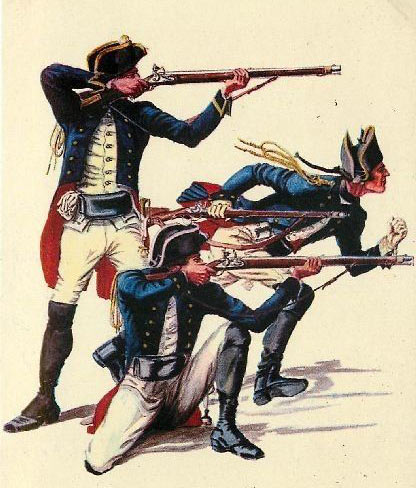
Brunswick Light Infantry: Battle of Hubbardton on 7th July 1777 in the American Revolutionary War
Casualties at the Battle of Hubbardton:
British and German casualties were 14 officers and 195 soldiers. American casualties were 12 officers and 300 soldiers. As the British held the field, the American wounded were mostly captured.
The casualties were high in this battle for the number of troops involved, reflecting the determination of the American Continental Regiments.

Officer and Grenadier of the 24th Foot: Battle of Hubbardton on 7th July 1777 in the American Revolutionary War
Follow-up to the Battle of Hubbardton:
The American retreat to the South continued with the British in pursuit.
Anecdotes from the Battle of Hubbardton:
- It is reported in Fortescue’s account of the battle that a party of American soldiers approached the British line with their arms reversed, a token that they intended to surrender. The British withheld their fire. The Americans fired a volley, causing a significant number of casualties, and withdrew. This sort of “ruse de guerre” has been common in warfare. It seems unlikely that any such incident would have happened on as large a scale as is suggested by Fortescue.
- Lieutenant Colonel Seth Warner, of Bennington, Vermont, was a veteran of the French and Indian War. Brought up in the backwoods, Warner was a knowledgeable naturalist using plants and herbs for medicinal purposes. He was also a ‘fortunate and knowledgeable hunter’. Warner was a captain in the ‘Green Mountain Boys’, the force assembled to resist New York attempts to take over the area and was outlawed by the New York authorities for striking a New York justice. When, in 1775, Congress adopted the ‘Green Mountain Boys’ as a Continental regiment, Warner was elected lieutenant colonel and commanding officer. Following the devastation of the ‘Green Mountain Boys’ by disease and casualties in the invasion of Canada, Warner was commissioned to raise a new regiment to be called Warner’s Additional Regiment. Recruitment was slow and it was under strength when it took part in the Battle of Hubbardton. Warner took an active part in the decisive American victory of Bennington.
References for the Battle of Hubbardton:
History of the British Army by Sir John Fortescue
The War of the Revolution by Christopher Ward
The American Revolution by Brendan Morrissey
Saratoga by Richard Ketchum
The previous battle of the American Revolutionary War is the Battle of Fort Ticonderoga 1777
The next battle of the American Revolutionary War is the Battle of Bennington
To the American Revolutionary War index