The battle on 30th April 1745 that gave the British and Hanoverian infantry a reputation for dogged bravery
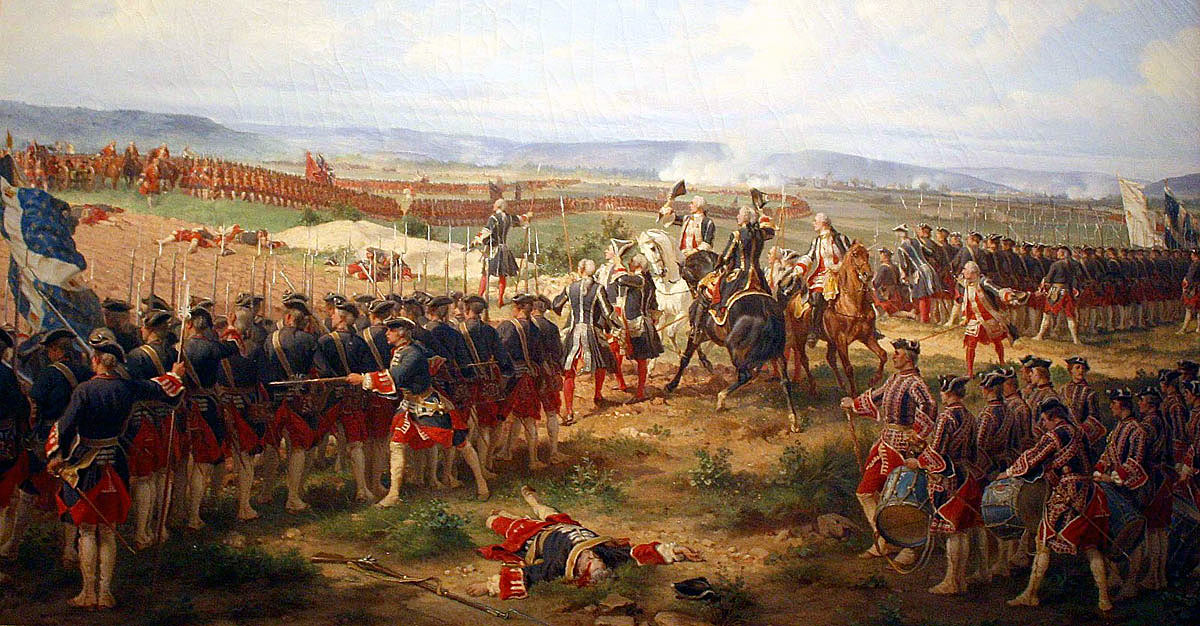
Lord Charles Hay of the First Foot Guards challenges the Gardes Francaises at the Battle of Fontenoy on 30th April 1745: picture by Edouard Detaille
The previous battle of the War of the Austrian Succession is the Battle of Dettingen
The next battle of the War of the Austrian Succession is the Battle of Roucoux
To the War of the Austrian Succession index
War: War of the Austrian Succession or King George’s War (the name in North America)
Date of the Battle of Fontenoy: 30th April 1745 (old style) (11th May 1745 new style)
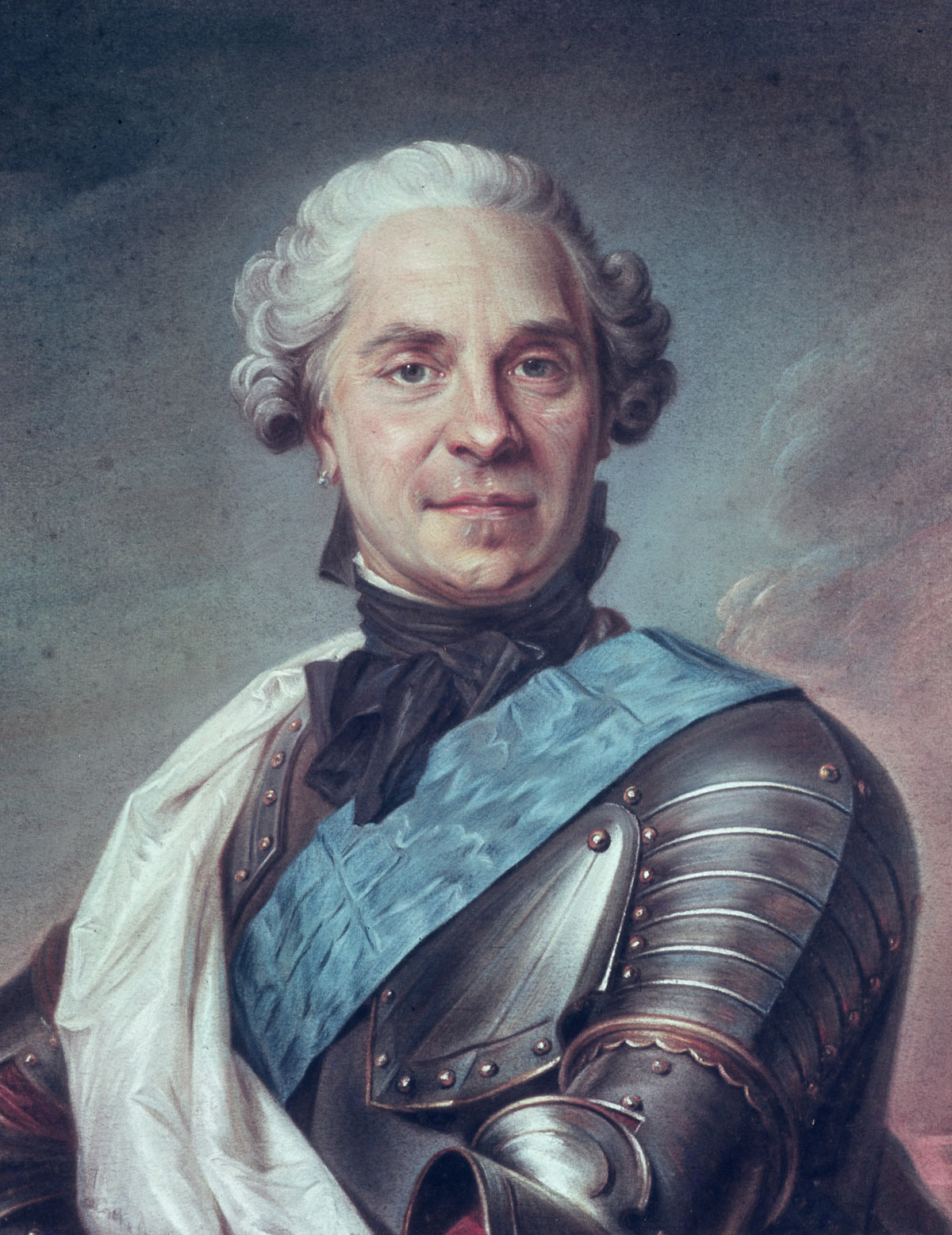
Marshal Maurice de Saxe commander of the French Army at the Battle of Fontenoy on 30th April 1745 in the War of the Austrian Succession: picture by de la Tour
Place of the Battle of Fontenoy: East of the Scheldt opposite Tournai around the villages of Fontenoy, Vezon and Anthoine in South West Belgium.
Combatants at the Battle of Fontenoy: British, Hanoverians, Austrian and Dutch forming the Pragmatic Army against the French.
Generals at of the Battle of Fontenoy: The Duke of Cumberland commanded the British contingent and due to his rank as the son of King George II had overall command of the Pragmatic Army. Marshal Königsegg commanded the Austrian contingent and the Prince of Waldeck commanded the Dutch.
Marshal Saxe commanded the French Army. King Louis XV of France was present at the battle.
Size of the Armies at the Battle of Fontenoy: 56,000 French against 50,000 British and allies.
Winner of the Battle of Fontenoy: The French.
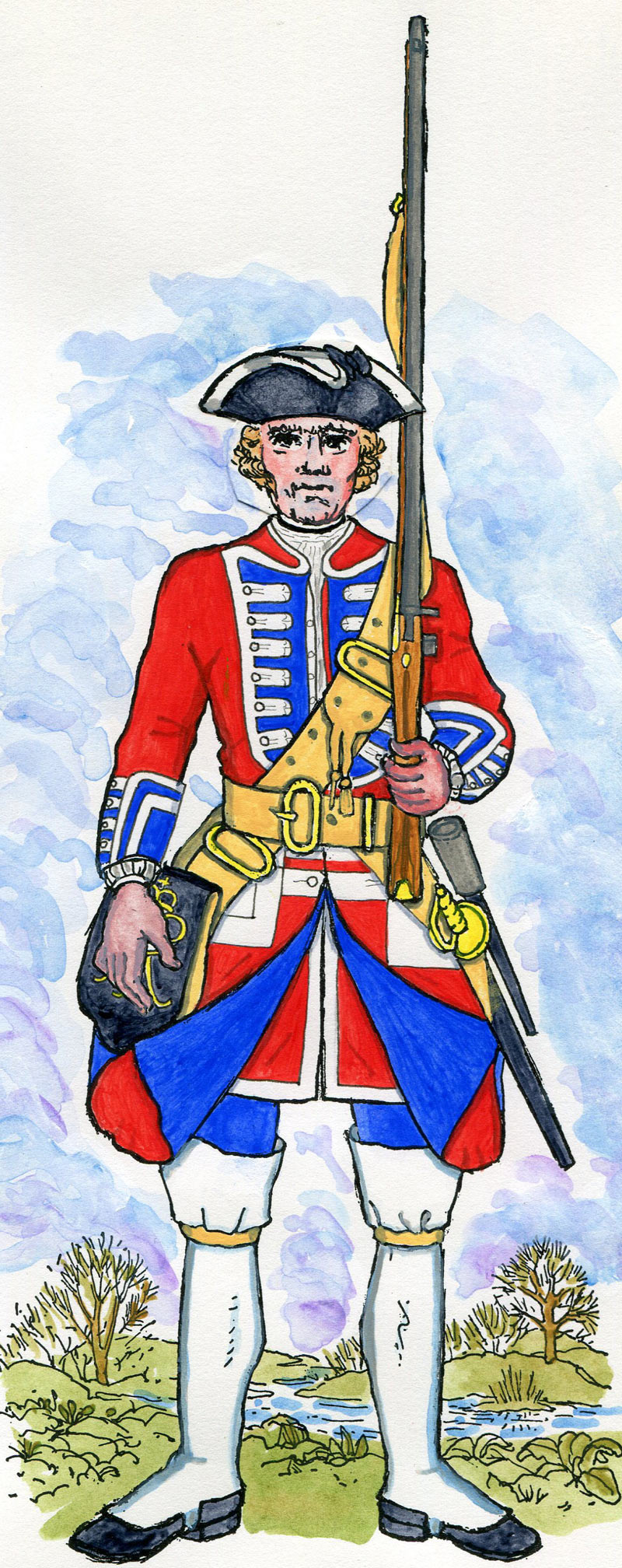
1st Regiment of Foot Guards: Battle of Fontenoy on 30th April 1745 in the War of the Austrian Succession: picture by Mackenzie after Representation of Cloathing
British Regiments at the Battle of Fontenoy: Fontenoy is not a battle honour for British regiments.
The British contingent comprised:
Cavalry: 3rd and 4th (Scots) Troops of Horse Guards, 2nd (Scots) Troop of Horse Grenadier Guards, Royal Horse Guards or ‘Blue Guards’, King’s Regiment of Horse, Ligonier’s 8th Regiment of Horse or the Black Guards, Hawley’s Royal Regiment of Dragoons, Campbell’s Royal North British Dragoons or Royal Scots Greys, Bland’s or King’s Own Dragoons, Cope’s or Queen’s Regiment of Dragoons, Stair’s or 6th Inniskilling Dragoons
Foot: 1st, 2nd and 3rd Foot Guards, 1st Royals, Lieutenant-General Howard’s 3rd Buffs, Onslow’s 8th, Sowle’s 11th, Duroure’s 12th, Pulteney’s 13th, Major-General Howard’s 19th, Bligh’s 20th, Campbell 21st Royal Scots Fusiliers, Huske’s 23rd Royal Welsh Fusiliers, Earl of Roth’’s 25th, Bragg’s 28th, Handyside’s 31st, Skelton’s 32nd, Johnson’s 33rd, Cholmondeley’s 34th, Lord Sempill’s 42nd Black Watch.
Royal Artillery: 10 six pounders, 4 eight inch howitzers, 27 three pounders and 6 one and a half pounders: commanded by Colonel Lewis.
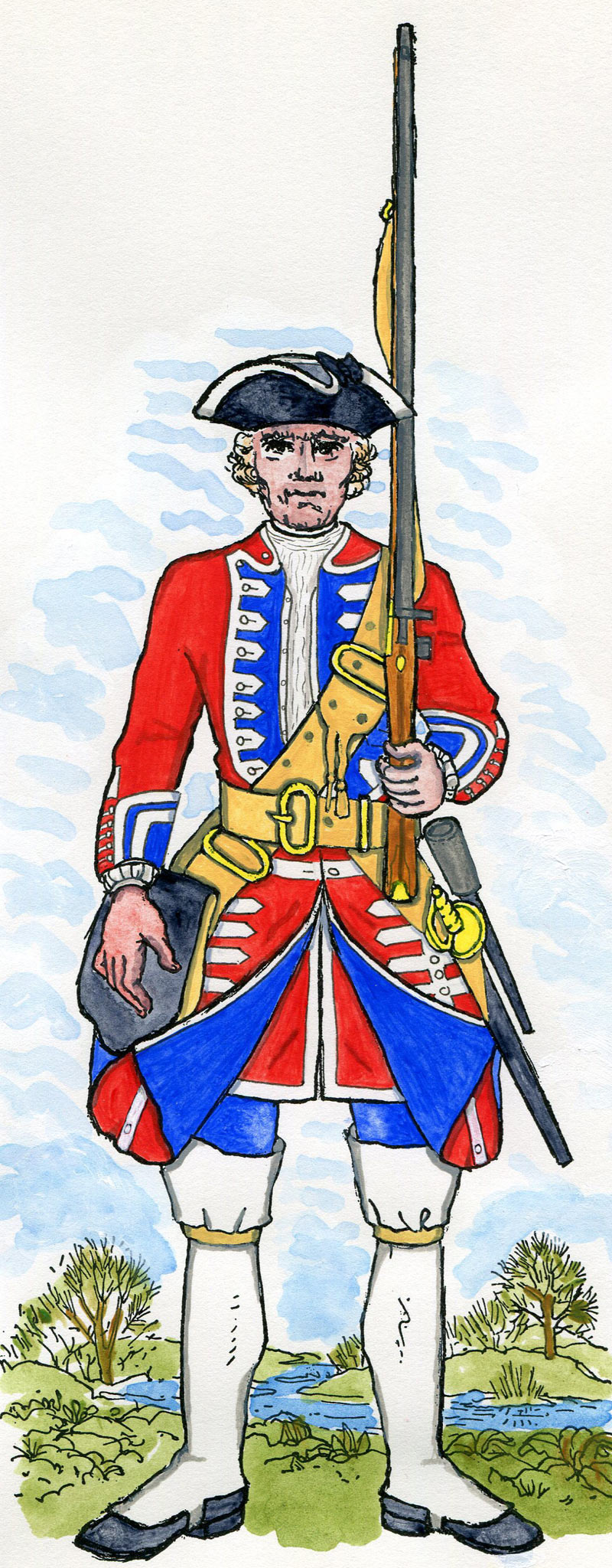
2nd Coldstream Regiment of Foot Guards: Battle of Fontenoy on 30th April 1745 in the War of the Austrian Succession: picture by Mackenzie after Representation of Cloathing
Sir John Ligonier commanded the infantry. Lord Albemarle commanded the Foot Guards. First line of infantry was commanded by Major-General Ponsonby and Pulteney. Second line of infantry was commanded by Major-Generals Howard, St Clair and Campbell
Hanoverian Regiments of Foot engaged with the British column: Böselager’s, Zastrow’s, Spörcken’s, Oberg’s and Campen’s.
Account of the Battle of Fontenoy:
The 1745 campaign season began with the French army commanded by Marshall Saxe laying siege to Tournai, the important Flemish medieval city lying in the south-west of Flanders on the west bank of the Scheldt. The Duke of Cumberland, the favourite second son of King George II, had been appointed to the command of the Pragmatic Army that year, at the age of 24. His Royal Highness set his army in motion to relieve the Dutch garrison in Tournai.
Marching up the main highway from Mons to Tournai brought the Pragmatic Army to the village of Vezon. From Vezon the highway led up an incline parallel to the edge of the Barry Wood to a plateau and on to Tournai.
The Allies encamped to the east of Vezon on 28th April 1745. In the evening the senior commanders, the Duke of Cumberland, Marshal Königsegg commanding the Austrians and the Prince of Waldeck commanding the Dutch, rode forward to reconnoitre the French positions.
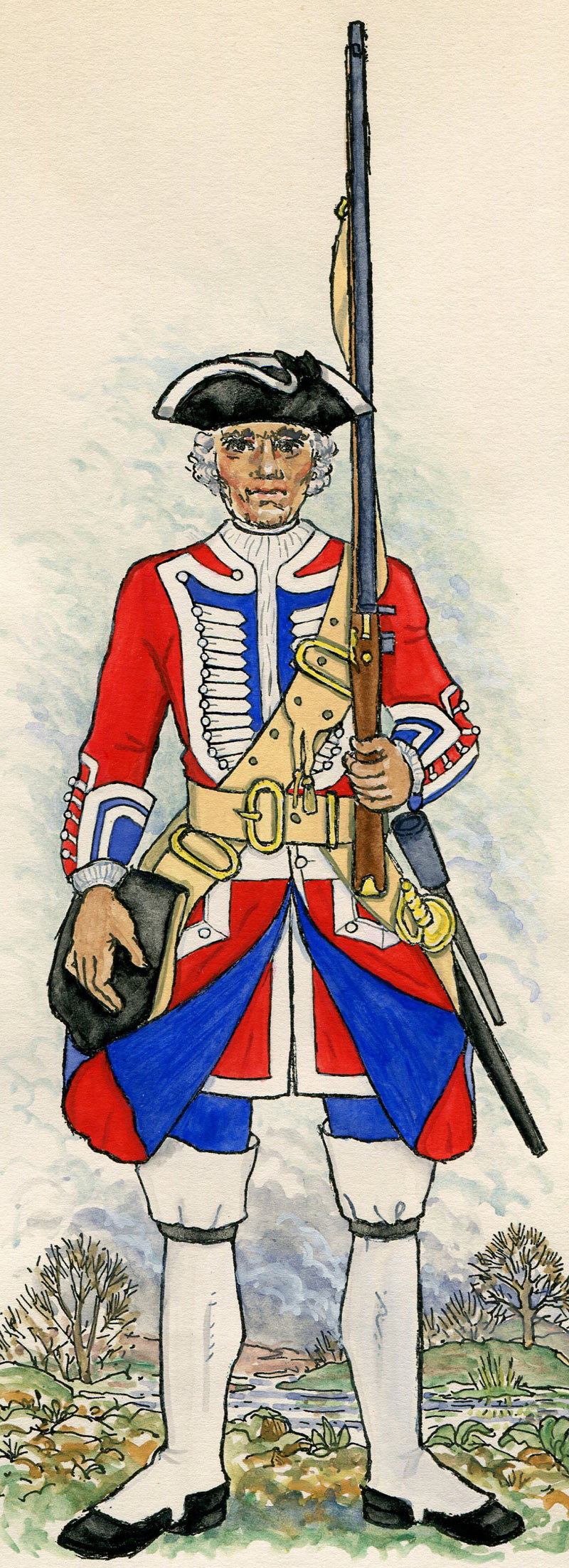
3rd Regiment of Foot Guards: Battle of Fontenoy on 30th April 1745 in the War of the Austrian Succession: picture by Mackenzie after Representation of Cloathing
The commanders discovered that the French held Vezon and Fontenoy. It was not possible to make out further details of the French positions beyond the woods and hillside.
The next day, on 29th April 1745, at a conference in the Duke of Cumberland’s quarters it was resolved to force the French out of Vezon in preparation for an advance up the incline to the main French positions.
The army’s task was to relieve the city of Tournai, under siege by the French. This could only be achieved by a successful attack on the French army holding the plateau and a forcing of the Scheldt River bridges.
In mid-morning, a force of British and Hanoverian cavalry, infantry (of the British, the 1st Foot Guards, 3rd Buffs, 8th, 11th and 42nd Foot) and guns commanded by Lord Crawford and the Hanoverian Brigadier Roseberg advanced on Vezon.
After brief resistance, the French withdrew up the slope behind Vezon. The Duke of Cumberland moved forward and established his headquarters in the captured village.
Lord Crawford recommended that troops should push into the Wood of Barry on the right flank but the Duke took no action on this recommendation at this stage.
The Pragmatic Army formed up for the main battle behind the Wood of Vezon, the Black Watch with two free companies on the extreme right, facing the angle of Barry Wood.
The British Guards Brigade formed up 200 yards from the Highlanders with, to its left, the Brigades of Ponsonby’s and then Onslow’s (the names of the brigades were taken from the senior regiment not the brigade commander). In the second line were the Brigades of Howard’s, Bland’s and Skelton’s.
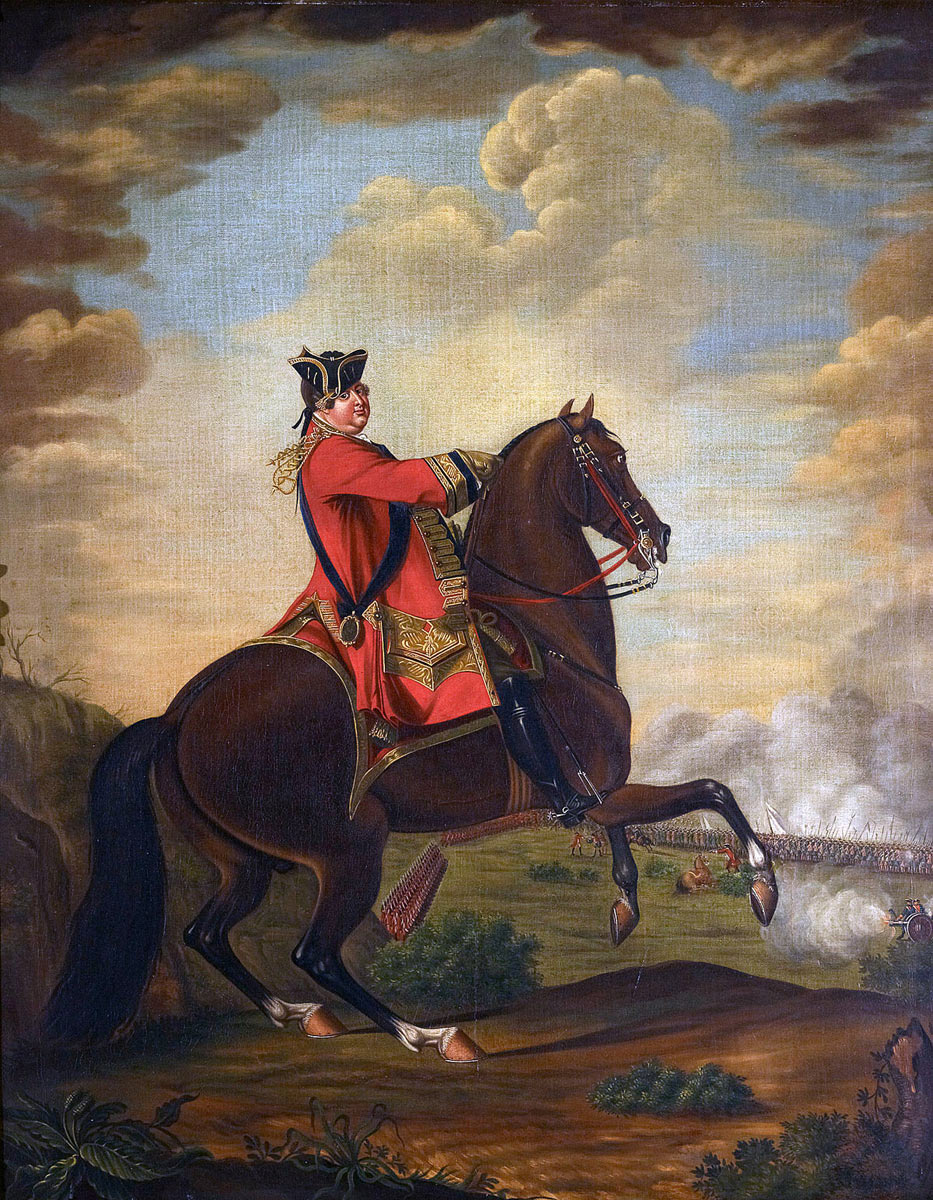
Duke of Cumberland: Battle of Fontenoy on 30th April 1745 in the War of the Austrian Succession
The Hanoverian Foot stood to the left of the British with their cavalry behind them. The British cavalry formed on the right wing at the rear.
The Dutch troops took up position on the left of the Hanoverians, their line curving round to the village of Peronne.
Once the Pragmatic Army was formed up it was late and it was decided to attack the next day, the troops bivouacking overnight in their battle positions.
Marshal de Saxe, the French commander, planned his battle tactics on the assumption that the French Foot could not be relied upon to stand up to the British and Hanoverian Foot in open battle. Saxe chose to defend his position by way of a system of redoubts.
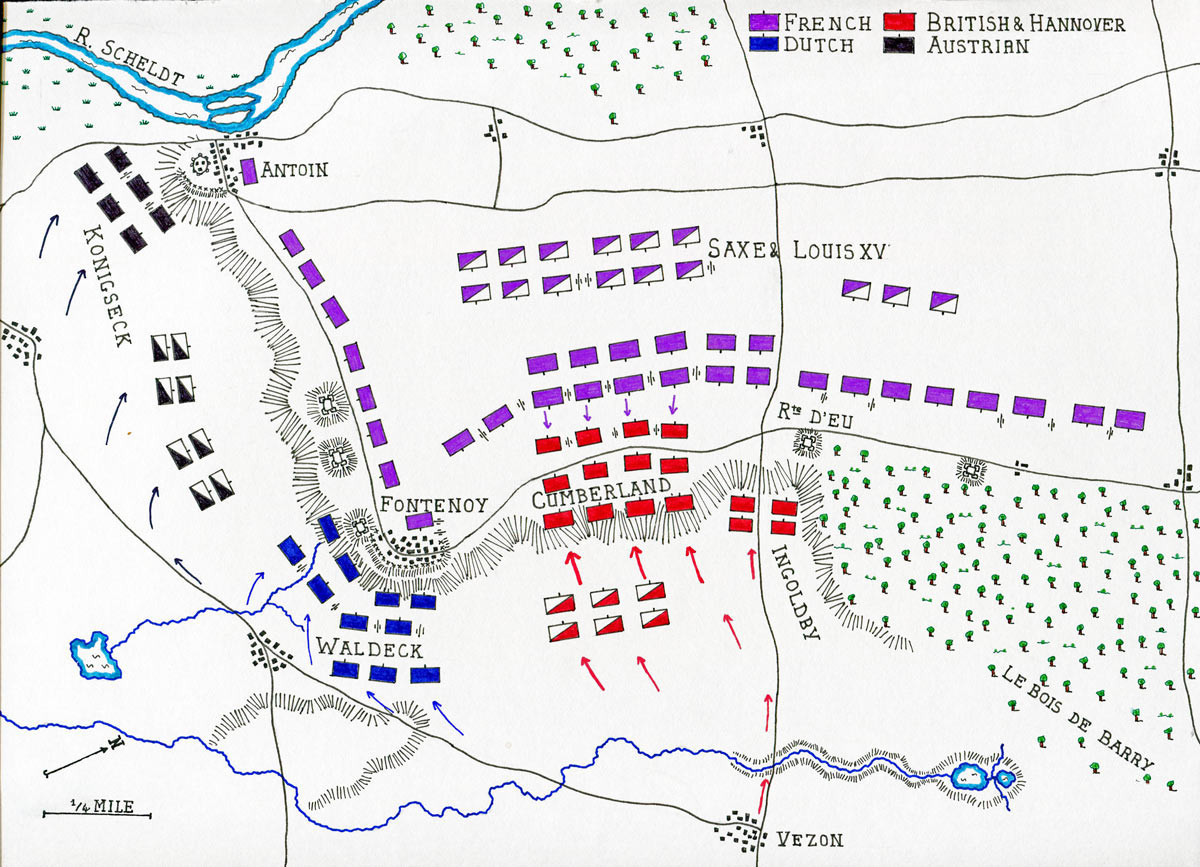
Map of the Battle of Fontenoy on 30th April 1745 in the War of the Austrian Succession: map by John Fawkes
The French Army held the fortified villages of Fontenoy and, on the bank of the River Scheldt, Anthoin. With the withdrawal from Vezon there was a gap across the incline leading up to the main French Army’s position between Fontenoy and Barry Wood.
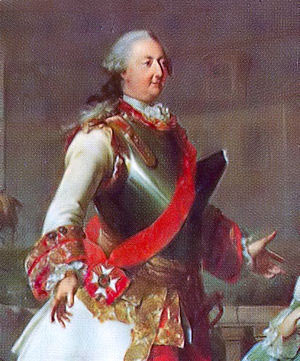
Charles August Prince of Waldeck and Pyrmont: Battle of Fontenoy on 30th April 1745 in the War of the Austrian Succession
On the edge of Barry Wood a fortified post was held by the Regiment D’Eu, called the ‘Redoute D’Eu’. The existence of this redoubt escaped the notice of the Duke of Cumberland.
At the top of the incline, on the plateau a mile deep by two miles wide, stretching from Anthoin and Fontenoy on the southern boundary to behind the Barry Wood on its northern side, Saxe formed the French Army with lines of infantry, cavalry and guns, other than the small proportion of its strength devoted to the fortified points. The French army on the plateau above Fontenoy comprised 66,000 men in 66 battalions and 129 squadrons. Present with the Marshal de Saxe was his sovereign King Louis XV of France. The Marquis de Dreux-Brézé held the trenches containing the garrison of Tournai with 22,000 men.
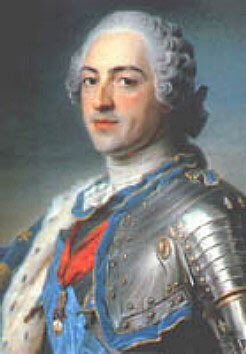
Louis XV King of France: Battle of Fontenoy on 30th April 1745 in the War of the Austrian Succession
Anthoin was held by 4 battalions of the Regiment Piedmont and 1 of Royal Marine. Swiss regiments held the entrenchments between Anthoin and Fontenoy. 3 battalions of the Brigade Dauphin held Fontenoy. A battalion of the Eu Regiment held the Redoute D’Eu with a screen of Grassin light troops and more Swiss troops in the wood line. On the far side of the River Scheldt a battery of 12 pounder guns waited to fire into the flank of any force attacking Anthoin.
In this system of defences Saxe’s major oversight was to fail to position a redoubt half-way between Fontenoy and the Redoute D’Eu, leaving the half-mile of slope leading to the heart of the French Army on the plateau without a defensive mechanism other than the enfilade fire from the two flanking redoubts. Saxe considered this flanking fire sufficient to deter any attempt to advance up the incline.
A force of 6,000 foot from the Garde Francaises and Swiss Regiments held the crossings over the River Scheldt at Calonne. The remaining 53,000 troops were disposed on the plateau with the foot to the front and the cavalry in the rear.
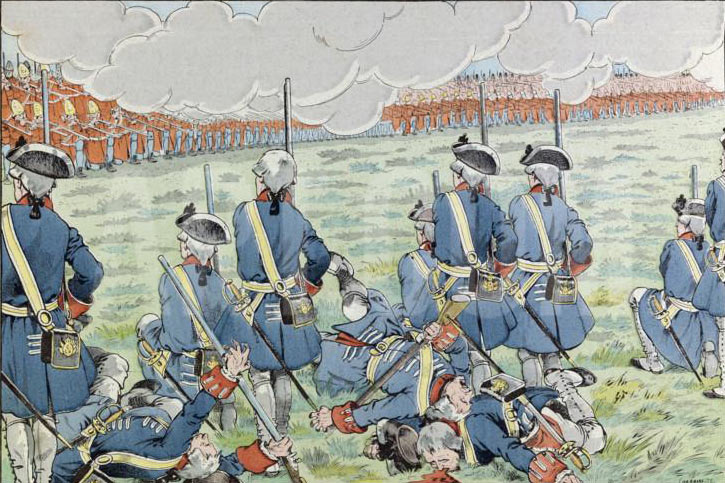
Les Gardes Françaises at the Battle of Fontenoy on 30th April 1745 in the War of the Austrian Succession: picture by Jacques de Breville
Picked troops faced the top of the incline between Fontenoy and the Barry Wood: 3 battalions of Le Roi at the Fontenoy end of the line with next in line; 1 battalion of Aubeterre, 3 battalions of Courten, 4 battalions of Gardes Françaises and 2 battalions of the Gardes Suisses. 2 batteries of 12 guns stood in front of the line of foot.
The French cavalry were posted 600 yards to the rear of the first line with the Household Cavalry behind this second line.
4 battalions of foot from the Crillon and Biron Regiments held the ground between Fontenoy and Anthoin, supported by 3 dragoon regiments; Royal, Beauffremont and Mestre-de-Camp.
The French reserves stood to the left behind the Barry Wood: in the first line the Irish Brigade of the regiments Clare, Ruth, Lally, Berwick, Dillon and Bulkeley. 2 late arriving regiments formed on the left of the Irish: Royal Corse and Normandie.
On the right of the Irish was the Royal Vaisseux and a battery of 4 guns. Behind the Irish was a line of French foot behind which stood two lines of French cavalry.
The French army encamped in its positions on the night before the battle.
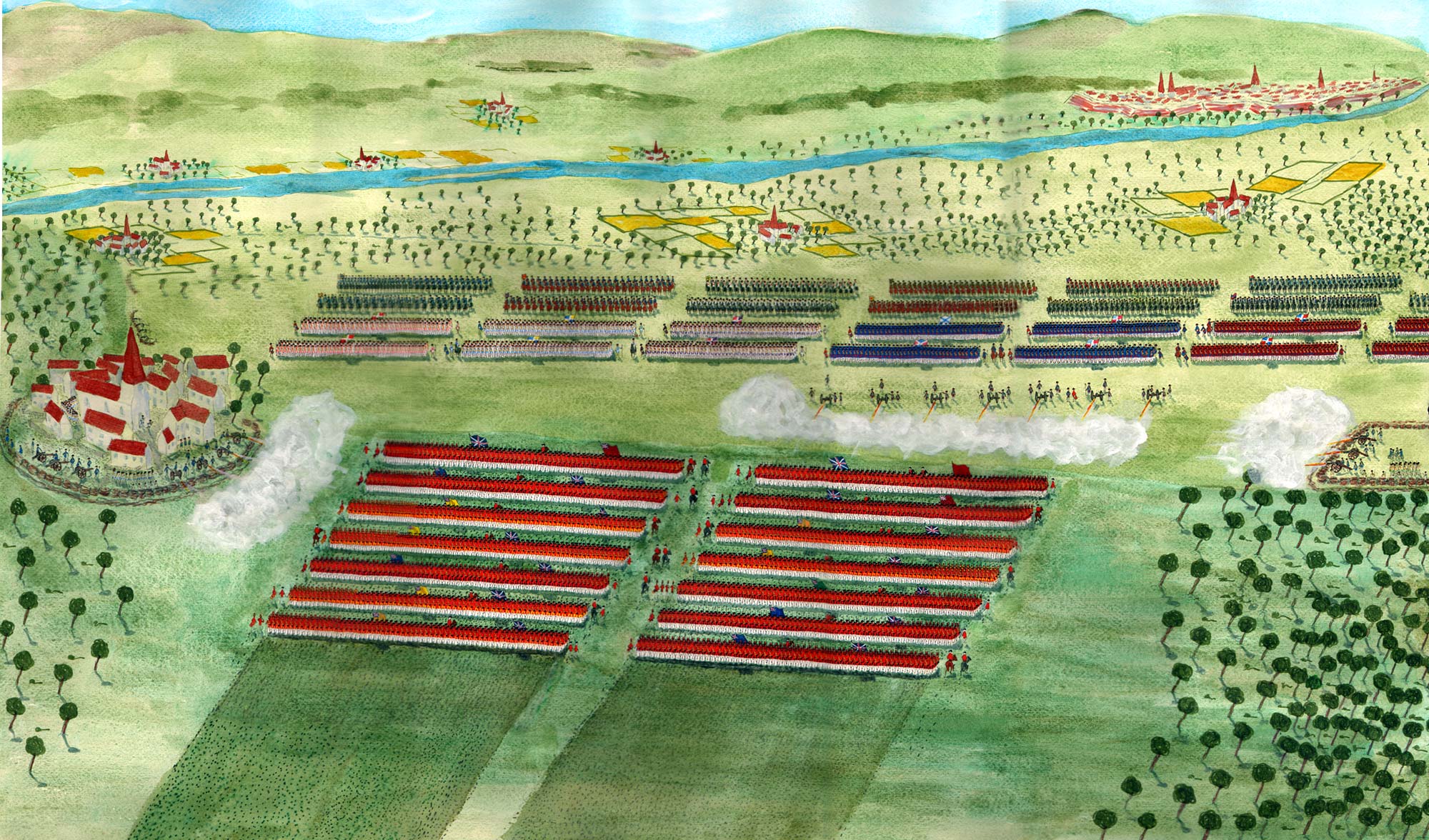
The columns of British and Hanoverian infantry advance up the incline into the heart of the French army at the Battle of Fontenoy on 30th April 1745 in the War of the Austrian Succession: illustration by John Mackenzie 2008
The Pragmatic army was astir at around 2am preparing for battle.
At 4am the Duke of Cumberland arrived at the right of the British infantry to command the assault on the French positions, to be told that a redoubt had been identified on the edge of the Barry Wood overlooking the incline up which the British foot were to advance; the Redoute D’Eu.
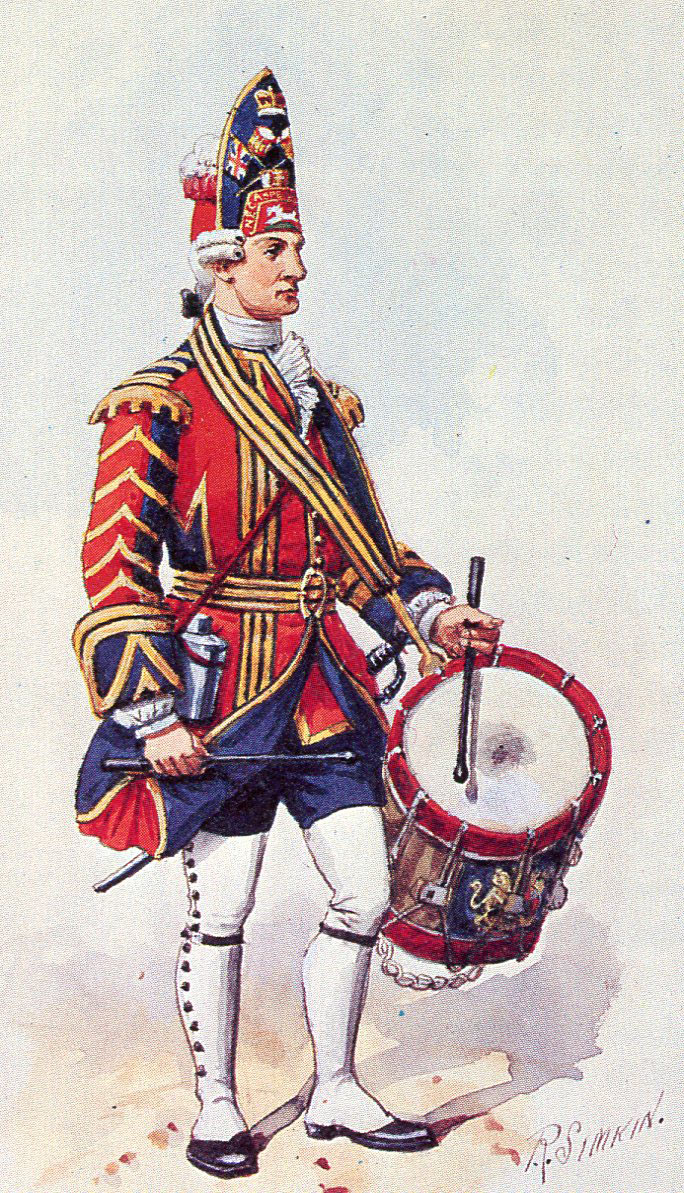
Drummer of the 1st Foot Guards: Battle of Fontenoy on 30th April 1745 in the War of the Austrian Succession
The Pragmatic commanders met in conference to discuss what action to take in the light of this discovery. It was decided that the assault up the incline between Fontenoy and the Barry Wood should be delayed while the Dutch troops attacked Fontenoy and Anthoin and a British brigade stormed the Redoute D’Eu.
The Duke of Cumberland selected Brigadier Ingoldsby of the First Guards to command the assault on the Redoute D’Eu with Duroure’s 12th Foot, Pulteney’s 13th Foot, the Black Watch Highland Regiment and Böselager’s Hanoverian Foot.
Ingoldsby’s orders were to march up to the ‘French Battery’ and to seize the guns which were now firing on the British right wing. A detachment of men from the artillery train were to accompany the brigade and operate any captured guns against the French troops.
The failure of Ingoldsby to eliminate the threat from the Redoute d’Eu was to prove a major difficulty for the Pragmatic attack.
Moving past Vezon, Ingoldsby halted his brigade at the side of the road that ran up the incline to the main French positions half a mile short of the Redoute d’Eu and, after conducting a reconnaissance, sent a message to Cumberland asking for the support of guns.
While waiting for the guns, Ingoldsby consulted his senior officers as to a further course of action. Sir Robert Munro of Foulis commanding the Black Watch stated that he had sent a reconnaissance party into the Barry Wood and that there were French free companies along its border. He recommended that the brigade form up on the other side of the road and advance while his highlanders cleared the French troops from the woods. Ingoldsby accepted this advice but took no steps to implement it, simply awaiting the cannon.
Captain Mitchelson of the artillery, on Cumberland’s orders, brought up three 6 pounder cannon and opened fire on the wood edge, attracting heavy French cannon fire in response.
Ingoldsby brought his brigade further up the road, but seeing numbers of French Grassins along the edge of the wood baulked at launching an attack on the Redoute d’Eu despite further urgings from Cumberland.

Grenadiers of the 1st Guards storming the sunken roadway: Battle of Fontenoy on 30th April 1745 in the War of the Austrian Succession
As the advance of the whole Pragmatic army was waiting on Ingoldsby clearing the Redoute d’Eu and the Barry Wood of French troops Cumberland sent his ADC Lord Bury to enquire what was going on and followed himself. Ingoldsby clearly considered the task impracticable in view of the number of French troops lining the edge of the wood. Cumberland seems to have accepted this view and resolved to make the main attack without securing the Redoute d’Eu.
At 7am a signal of 4 cannon shots in quick succession was given. The Dutch cavalry advanced on Fontenoy and Anthoin, but, on coming under heavy cannon fire from both villages and from the battery on the far side of the Scheldt, promptly withdrew leaving the Dutch artillery to bombard the French positions.
At 6.30am Lieutenant-General Sir James Campbell brought 15 squadrons of British cavalry through Vezon, his orders being to cover the forming up of the main columns of British and Hanoverian infantry. The cavalry came under heavy fire from Fontenoy and the Redoute d’Eu. Campbell was fatally wounded and the cavalry withdrew behind Vezon.
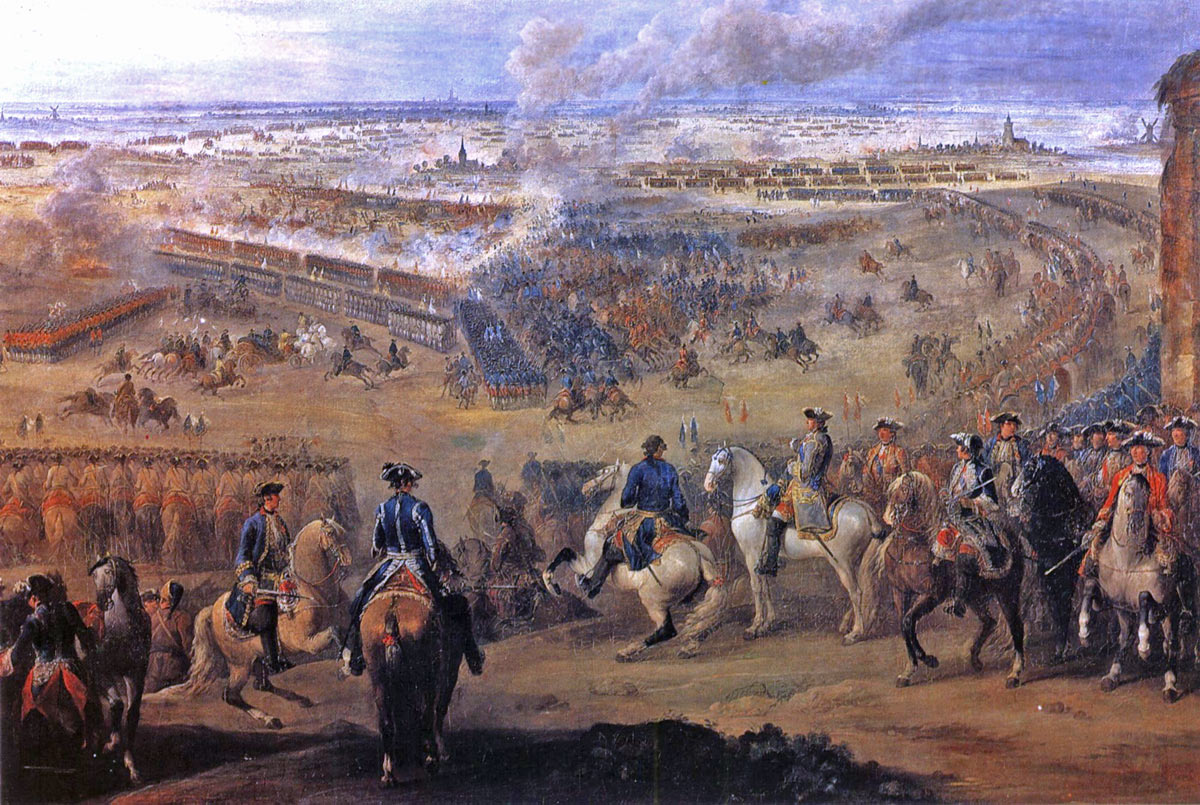
King Louis XV watches the Battle of Fontenoy on 30th April 1745 in the War of the Austrian Succession
The British and Hanoverian infantry under Sir John Ligonier marched through Vezon and began to form up in the open ground leading up the incline to the main French position. Here they in turn came under sustained bombardment from Fontenoy and from the Redoute d’Eu, the position Ingoldsby was meant to have neutralized.
French light galloper guns came forward over the lip of the hill and opened fire on the assembling British infantry, to be countered by seven British 3 pounders brought to the front of the foot to fire at the French up the slope.
It is reported that the Duc de Grammont, the French commander who had advanced so precipitately at the Battle of Dettingen, was killed in this exchange of fire.
At 9am the British and Hanoverian foot were formed and ready for the advance. Ligonier only waited on Ingoldsby to neutralize the French cannon fire from the Redoute D’Eu.
Ligonier’s ADC Captain Amherst was dispatched to enquire of Ingoldsby why he still failed to advance and received the reply from Ingoldsby that his orders from the Duke of Cumberland were now to advance in conjunction with the rest of the British infantry.
On the left the Dutch infantry commanded by the Prince of Waldeck moved forward in columns to attack Fontenoy and Anthoin, but were quickly repelled by the heavy French cannon fire from the two fortified villages and the redoubts built on the crest between them.
Marshal Königsegg and the Duke of Cumberland resolved that the British and Hanoverian infantry must attack up the incline between Fontenoy and the Redoute d’Eu, if there was to be any chance of relieving Tournai. However, a further attack must be made on Fontenoy to relieve the columns of the cannon fire from at least one flank.

The Black Watch at the Battle of Fontenoy on 30th April 1745 in the War of the Austrian Succession: picture by Skeoch Cumming (the uniforms and headgear are not accurate for the period)
The Black Watch was withdrawn from Ingoldsby’s brigade and dispatched to head the assault on Fontenoy.
The Highlanders attempted to penetrate Fontenoy but were driven back. The Dutch effort against the French positions was half-hearted and they were finally driven off by a charge on their left flank by French dragoons. The Dutch took no further part in the battle leaving the main attack to the British and Hanoverians.
At around midday the Duke of Cumberland took his place with the two British and Hanoverian infantry columns and ordered the advance to begin up the incline to the French positions on the plateau. Twelve 6 pounder guns were dragged along in advance of the infantry line.
The march up the half-mile of incline was carried out under cannon fire from Fontenoy and the Redoute d’Eu, firing from each flank, the main effect of which was to cause the Hanoverian battalions on the left to incline into the middle.
The British and Hanoverian infantry crossed the summit of the incline to find themselves confronted by the French army drawn up on the plateau.
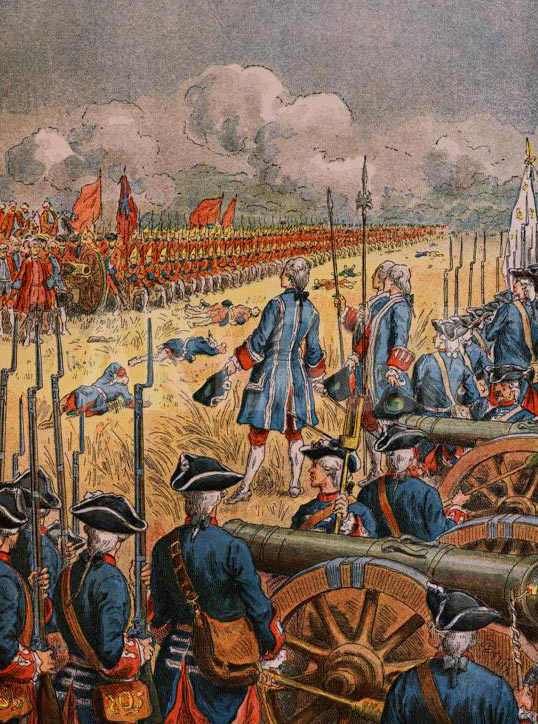
Les Gardes Françaises at the Battle of Fontenoy on 30th April 1745 in the War of the Austrian Succession: picture by Stefano Bianchetti
The leading French regiments of Garde Française, Garde Suisse and the regiment of Aubeterre were positioned along the lane that led from Fontenoy along the crest.
There was an exchange of fire, the French volley being largely ineffective while the volleys from the British Guards regiments at the head of the column swept away sections of the French line, reportedly inflicting 700 casualties. The remnant of the French line dispersed in confusion.
The Third Guards required some steadying by their commander Lord Panmure before the British column resumed its advance, penetrating some 300 yards beyond the lip of the incline, well into the positions of the French on the plateau.
King Louis XV was present in the French lines with a considerable following of civilian courtiers eager to watch the battle. This was however before it was realised that there was to be an assault on the main French position.
The King’s presence now became a considerable embarrassment to Marshal de Saxe, who was attempting to organise the repulse of the advancing British and Hanoverian columns. In considerable pain from dropsy Saxe was conveyed around the battlefield in a wicker chair carried by a team of grenadiers.
Saxe mounted a horse and rode over to the point of combat to organise the resistance to the advancing British and Hanoverian foot. On his way, Saxe checked the safety of King Louis XV who had rejected the urgings of his courtiers to leave the battlefield.
The regiment of Aubeterre attempted to stem the British and Hanoverian advance attacking the columns with a number of other French regiments: Le Roi on the British right, Royal Vaisseaux, Hainault, Royal Infanterie, Soissonais and La Couronne.
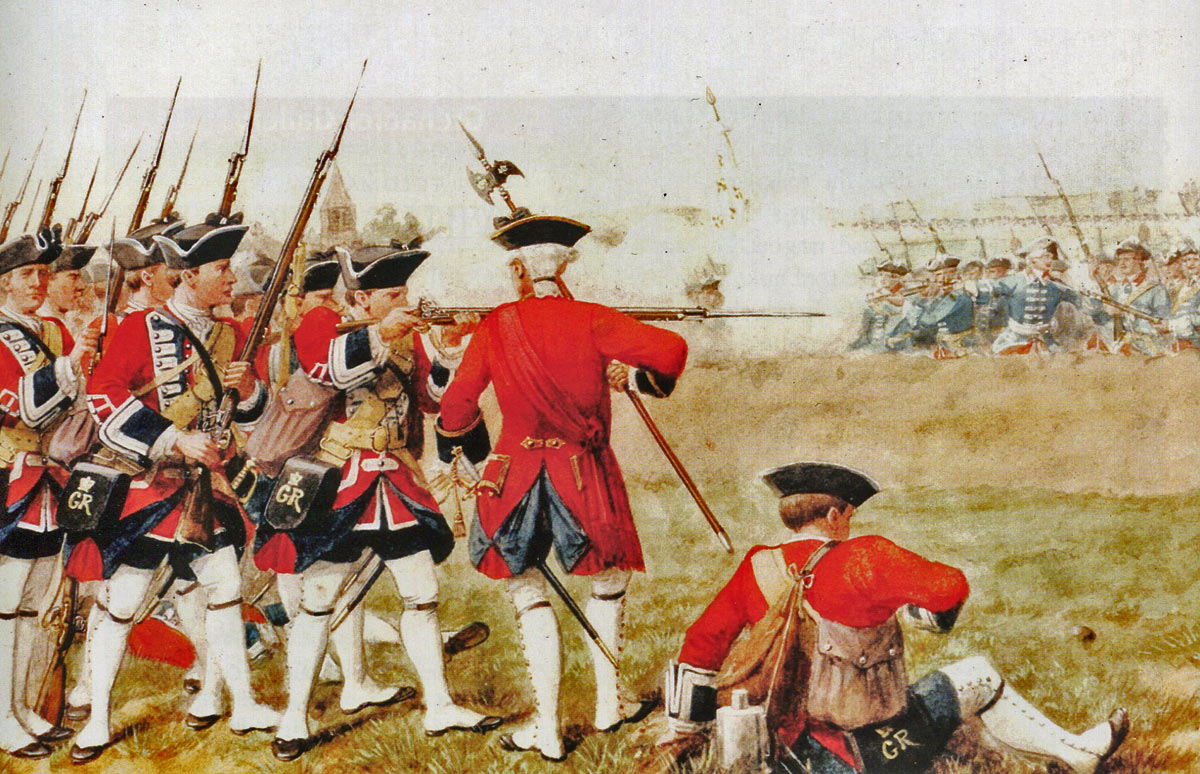
1st Foot Guards at the Battle of Fontenoy on 30th April 1745 in the War of the Austrian Succession
This attack pushed the British and Hanoverians back to the crest of the incline where order was re-established and the advance resumed.
Saxe launched a number of French cavalry regiments against the British and Hanoverian infantry, but the charges were not well coordinated and the French were repelled without pressing their charges home.
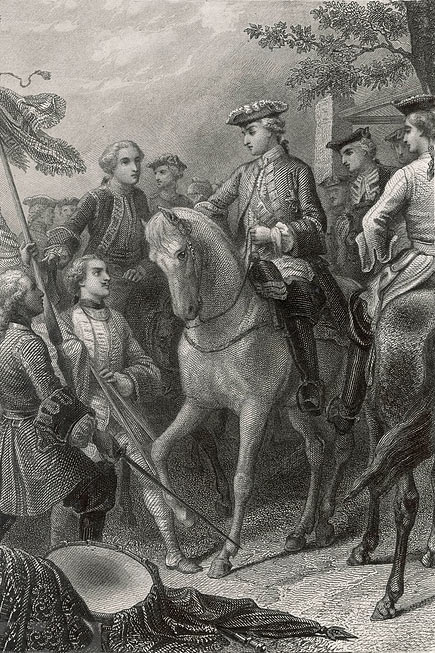
Louis XV King of France at the Battle of Fontenoy on 30th April 1745 in the War of the Austrian Succession
Behind these disparate cavalry attacks Saxe was organising a further infantry assault on the columns.
The last mounted charge was delivered by 4 squadrons of Gendarmerie and the Regiment of Carabiniers of the King’s Household Cavalry. Their charge while more determined was driven back with considerable loss, twenty-seven officers becoming casualties.
Under Saxe’s immediate guidance the French infantry assault was resumed with the Royal Vaisseaux, Hainault, Normandie and Dillon’s Irish Regiment. Again they were repelled by the British and Hanoverians.
At 1pm Marshal de Saxe made his way to Fontenoy to find the French guns were now without ball and were firing blank rounds. Aware that the crisis in the battle had been reached Saxe sent word to King Louis XV that he should withdraw across the River Scheldt. Saxe also directed that the guns be removed from the redoubts and taken to safety across the Scheldt.
This would have been the moment for the Dutch troops to renew their attack on the Fontenoy-Anthoin line, but they were given no orders to move.
At around 1.30pm a Captain Isnard of the Touraine Regiment saw four cannon uninvolved in the combat. Isnard urged that they be brought forward, along with other cannon also lying idle, and used to combat the British advance. This was done and, at point blank range, grapeshot was discharged into the British columns cutting swathes through the ranks.
Taking advantage of the change in French fortunes Marshal de Saxe rallied all the infantry regiments in the vicinity of the British columns and launched them in attack.
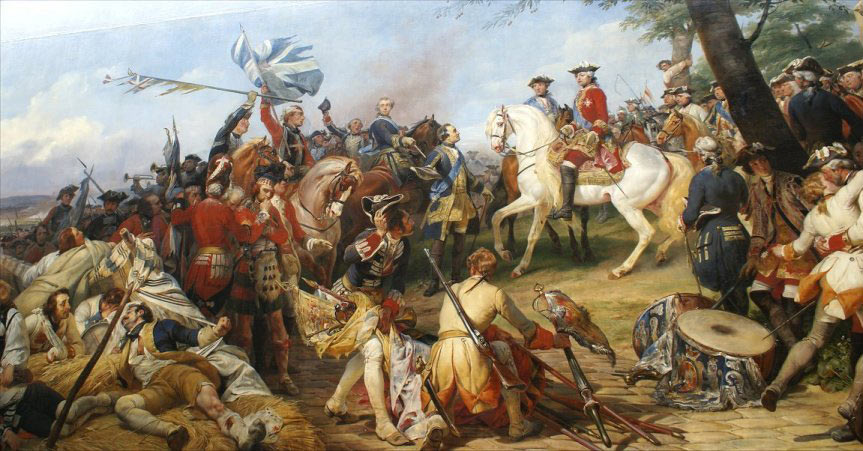
Marshal Maurice de Saxe the victor of the Battle of Fontenoy on 30th April 1745 in the War of the Austrian Succession: picture by Horace Vernet
On the urgings of Count Lally-Tollendal, Saxe ordered up the regiments of the Irish Brigade which joined the French regiments in assaulting the right of the column. The Garde Française and the Garde Suisse rallied and returned to the attack in the centre.
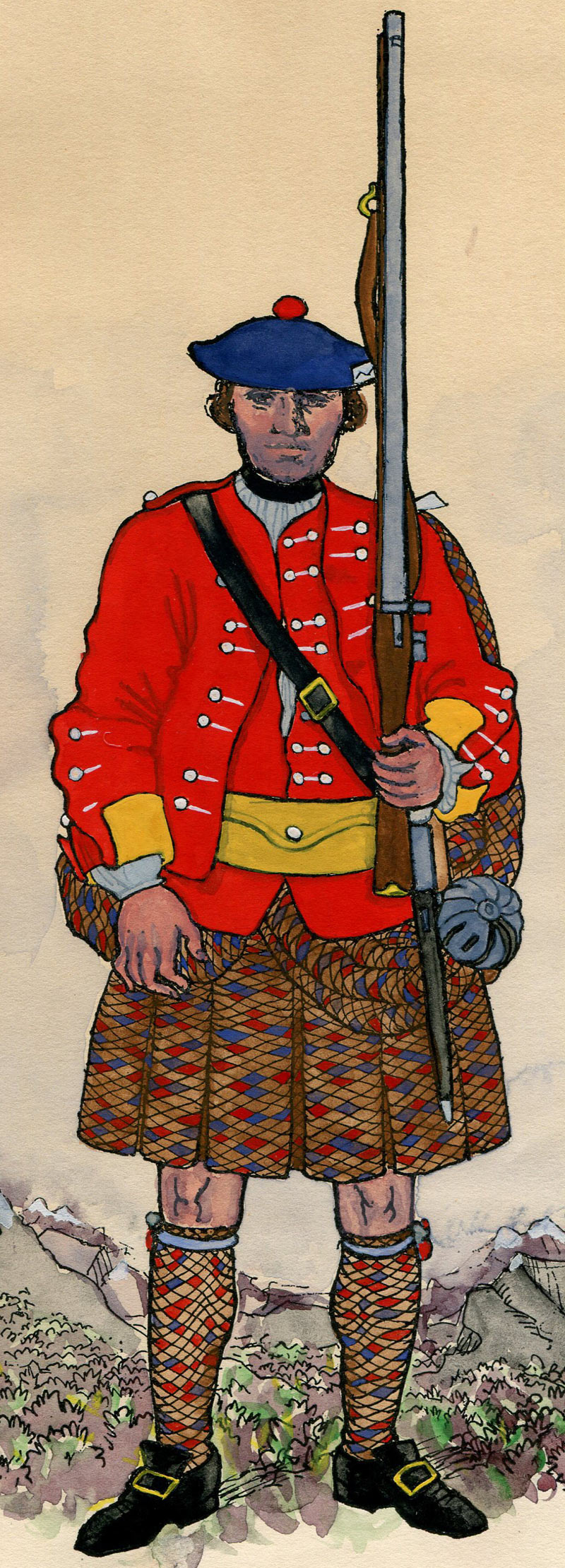
The Highland Regiment: Battle of Fontenoy on 30th April 1745 in the War of the Austrian Succession: picture by Mackenzie after Representation of Cloathing
The regiments withdrawn from the redoubts between Fontenoy and Anthoin assaulted the British left wing.
In support of the infantry attack the whole of the French Household Cavalry charged the centre of the column.
It was now late afternoon and the British and Hanoverian regiments of foot, short of ammunition, were pressed back down the incline.
The French regiments of horse, the Carabiniers and de Noailles, circled around the columns and attacked the rear, to be driven off by British foot and the Hanoverian Zastrow Regiment.
Howard’s 3rd Old Buffs, continuing to advance into the French lines, had to be recalled by Sir John Ligonier in person and ordered to join the retreat.
At the foot of the incline, Skelton’s 32nd and Cholmondeley’s 34th foot acted as a rearguard, while the 3rd Old Buffs held the Vezon Churchyard. The Highlanders of the Black Watch lined the hedgerows and fired at the advancing French. The British cavalry formed a protective shield on the flanks of the withdrawing columns.
Saxe halted the French advance a hundred yards or so short of Vezon. He considered the battle finished. Tortured by his illness the marshal withdrew to be treated by his surgeons.
The Pragmatic Army reformed behind Vezon and continued the fifteen-mile march to Ath, leaving the French victorious on the Battlefield.
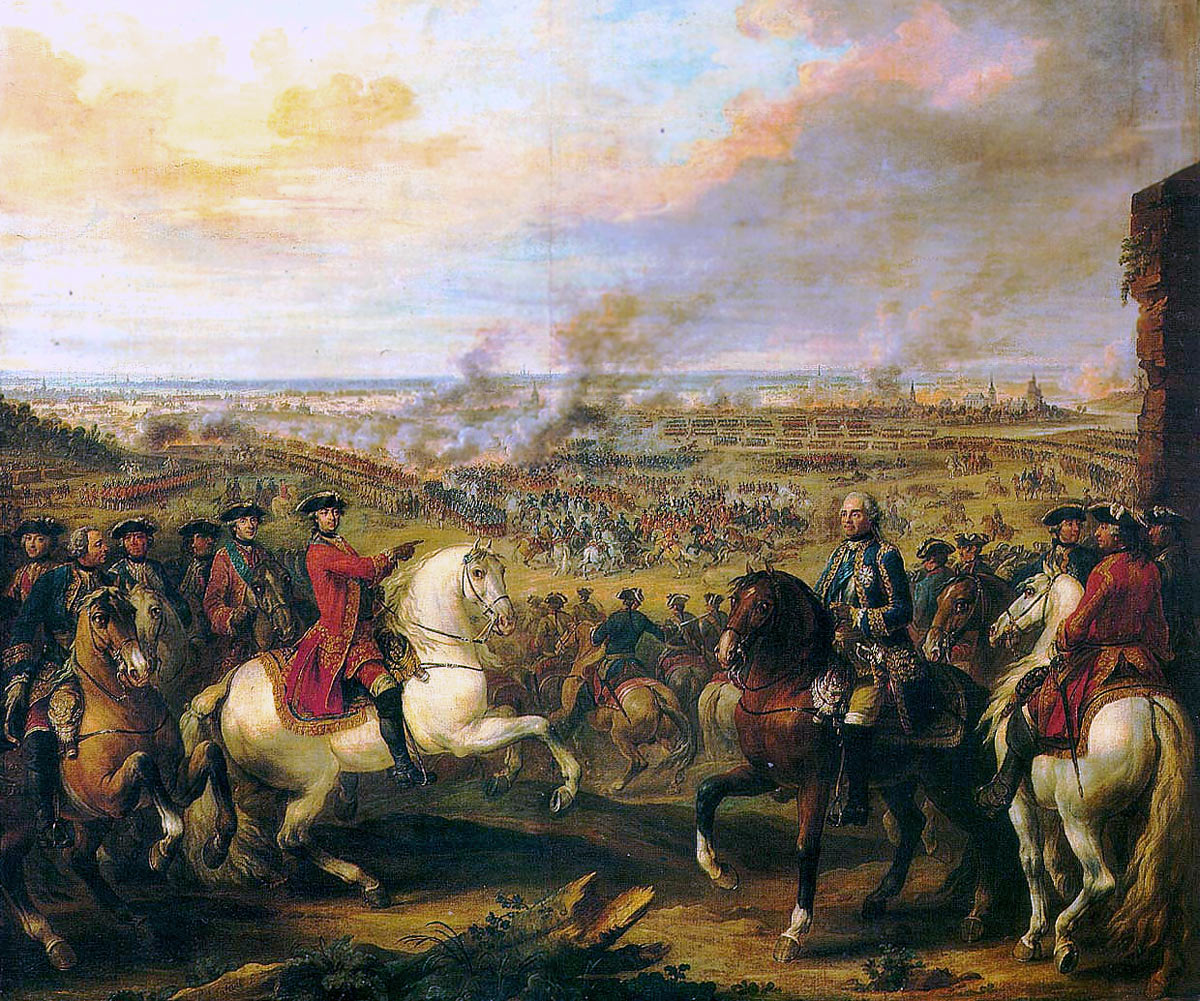
King Louis XV points at Marshal Maurice de Saxe the victor of the Battle of Fontenoy on 30th April 1745 in the War of the Austrian Succession: picture by Pierre Lenfant

Duroure’s 12th Regiment of Foot: Battle of Fontenoy on 30th April 1745 in the War of the Austrian Succession: picture by Mackenzie after Representation of Cloathing
Casualties at the Battle of Fontenoy:
British and Hanoverian infantry: of the 15,000 engaged nearly 6,000 became casualties in the battle, either killed, wounded or missing (the Royal Scots Fusiliers reported 129 missing): the greatest numbers of casualties were from these regiments: 23rd Royal Welsh Fusiliers (322 killed, wounded or missing), Duroure’s 12th (321 killed, wounded or missing), 1st Foot Guards (240 killed, wounded or missing), 2nd or Coldstream Foot Guards (239 killed, wounded or missing), 3rd Foot Guards (247 killed, wounded or missing), Campbell’s 21st Royal Scots Fusiliers (247 killed, wounded or missing), Handyside’s 31st (286 killed, wounded or missing).
British cavalry: 168 killed and 483 wounded or missing.
Hanoverian infantry: 432 killed, 978 wounded and 50 missing.
Five Hanoverian regiments of foot suffered casualties comparable to the British regiments. The Regiment of Böselager suffered 377 killed, wounded or missing, the highest figure among British and Hanoverian regiments.
Hanoverian cavalry: 311 casualties (25% of number engaged)
Dutch: 1,544 killed and wounded
British General Officers: killed; Lieutenant-General Sir James Campbell and Major-General Ponsonby wounded; Lord Albemarle, Brigadiers Churchill and Ingoldsby: 7 colonels and lieutenant-colonels were killed or wounded.
Royal Welsh Fusiliers: 22 officers and 322 soldiers killed and wounded
Duroure’s 12th Foot: 19 officers including Colonel Scipio Duroure and the lieutenant-colonel and 321 soldiers killed and wounded.
The Black Watch lost: killed 3 officers and 30 men: wounded 3 officers 2 sergeants and 36 men.
British and Hanoverian Artillery lost 58 killed, wounded and missing.
French casualties were 5,337 infantry killed and wounded and 1,800 cavalry killed and wounded: total French killed and wounded 7,137
Follow-up to the Battle of Fontenoy:
The Pragmatic Army drew off after the battle and retreated leaving the field to the French. There was no pursuit. During the rest of 1745 Marshall Saxe captured Tournai and other Flemish cities. Later in the year most of the British regiments were called back to Britain following the outbreak of the Jacobite Rising in the Highlands of Scotland.
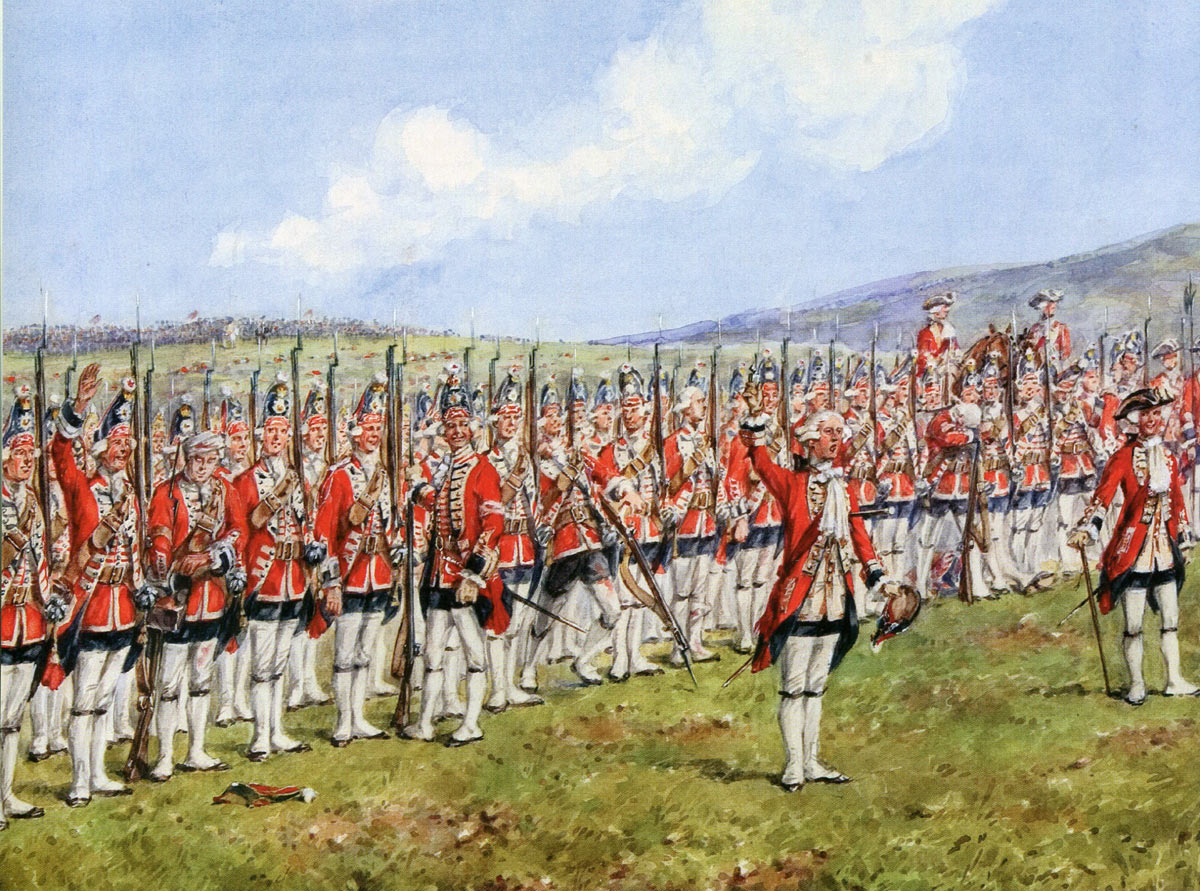
Lord Charles Hay and 1st Foot Guards at the Battle of Fontenoy on 30th April 1745 in the War of the Austrian Succession
Regimental anecdotes and traditions from the Battle of Fontenoy:
- The most celebrated anecdote of the battle relates to Sir Charles Hay, a captain in the 1st Foot Guards (illustrated). On reaching the brow of the incline the columns confronted the French line of Foot. Opposite the 1st Foot Guards were the Garde Francaise. This French regiment had given way at the Battle of Dettingen and in their precipitate retreat had tipped up one of the bridges of boats. Many had drowned.
- Sir Charles Hay is reputed to have doffed his hat and bowed to the French officers saying: “We are the English Guards. We remember you from Dettingen and intend to make you swim the Scheldt as you swam the Main.”
- The alternative story is that Sir Charles Hay said “Messieurs les Gardes Francaises, s’il vous plait tirez le premier.” Hay was wounded in the battle.
- The Black Watch employed the tactic of waiting until the French were about to fire a volley and throwing themselve to the ground so that the shots passed over them, before leaping up and engaging the French troops with the broadsword or musket and bayonet.
- The Highland Regiment’s officer casualties in the battle were: killed: Captain John Campbell, Ensign Lachlan Campbell; wounded: Captains Robert Campbell, Ronald Campbell and James Campbell. The Black Watch was a ‘family affair’ in those early days of the regiment.
- British officers involved in the battle included: Jeffrey Amherst as Sir John Ligonier’s adc, Lord George Sackville (tried by court martial after Minden 1759 and as Lord Germaine played a leading part in British policy during the American War of Independence).

General Sir John Ligonier commander of the British columns at the Battle of Fontenoy on 30th April 1745 in the War of the Austrian Succession
- On 15th July 1745 the Duke of Cumberland brought Brigadier Jamse Ingoldsby before a court-martial on a charge of disobedience to orders at the Battle of Fontenoy. The court comprised Lord Dunmore and eleven other general officers. The charge was “that he received orders from the Duke to attack a redoubt or battery in the last action near Fontenoy, which orders he did not execute.” Ingoldsby’s defence was that he received conflicting orders from the Duke of Cumberland. His understanding was that the Duke changed his instructions so he was not to attack the Redoute d’Eu but to attach his brigade on the right flank of the British columns and advance with them. This he did. Ingoldsby was wounded in the attack and his leading regiment, Duroure’s, suffered the largest number of casualties of any British regiment in the columns. The Duke did not give evidence. The court-martial convicted Ingoldsby of the charge. The sentence was imposed by King George II. Ingoldsby was suspended for three months and then permitted to sell his commission and leave the army.
- Fontenoy gave the British Foot a reputation for stubborn determination. It caused observers to express surprise at the weak performance of British troops at Prestonpans and Falkirk later the same year.
- A letter written to James Wolfe from a Captain Field described how the Blues regained their reputation at Fontenoy after galloping through a British regiment at the Battle of Dettingen, being broken twice at Fontenoy and each time reforming and returning to the charge.
References for the Battle of Fontenoy:
- William Augustus Duke of Cumberland by Evan Charteris
- Field Marshall Lord Ligonier by Rex Whitworth
- Fortescue’s History of the British Army Volume II
- Fontenoy by Francis Henry Skrine
- William Augustus Duke of Cumberland by Rex Whitworth
- Marshal of France: The life and times of Maurice de Saxe by Jon Mancip White
The previous battle of the War of the Austrian Succession is the Battle of Dettingen
The next battle of the War of the Austrian Succession is the Battle of Roucoux
To the War of the Austrian Succession index