Montcalm’s defeat of the British and American colonists at Fort Ticonderoga on 8th July 1758
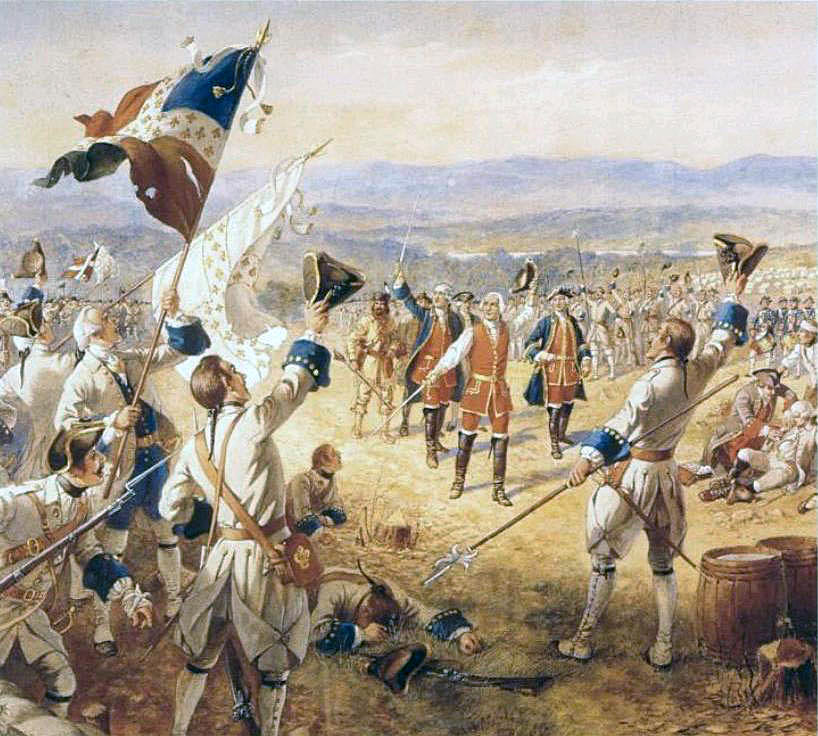
Marquis de Montcalm and French troops celebrating their victory at the Battle of Ticonderoga on 8th July 1758 in the French and Indian War
The previous battle of the French and Indian War is General Braddock’s defeat in 1755 Part 11
The next battle of the French and Indian War is the Capture of Louisburg
To the French and Indian War index
Battle: Ticonderoga
War: The French and Indian War also known as the Seven Year War (1757 to 1762)
Date of the Battle of Ticonderoga: 8th July 1758
Place of the Battle of Ticonderoga: At the southern tip of Lake Champlain in the United States, on the borders of northern New York State and Vermont.
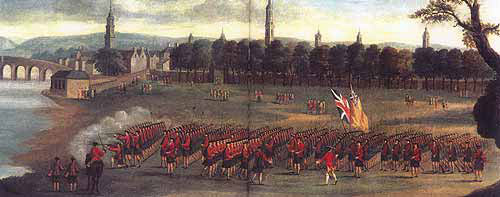
42nd Black Watch on Glasgow Green: Battle of Ticonderoga on 8th July 1758 in the French and Indian War
Combatants at the Battle of Ticonderoga: British and American colonial troops against French regular and colonial troops.
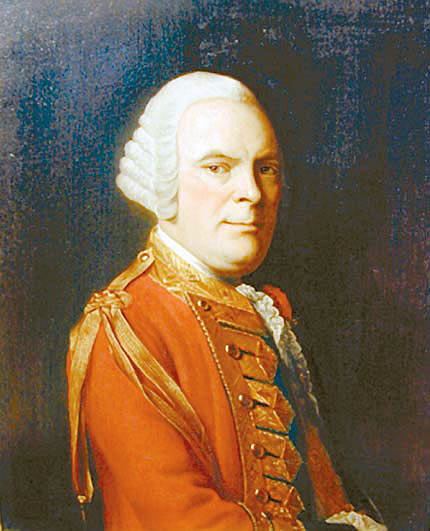
General James Abercrombie: Battle of Ticonderoga on 8th July 1758 in the French and Indian War
Commanders at the Battle of Ticonderoga: General James Abercromby and Brigadier Lord Howe commanded the British and Americans. The Marquis de Montcalm commanded the French.
Size of the armies at the Battle of Ticonderoga: 15,000 British and American Provincials. Around 3,600 French regular troops with a few Canadian provincials.
Uniforms, arms and equipment at the Battle of Ticonderoga: The French made use of guns emplaced on the walls of the fort, but essentially this was a battle of musket and bayonet. The English regiments were uniformed in red coats distinguished by regimental lace and facing colour, black tricorne hats or mitre caps for the grenadiers.
The American provincial regiments wore blue. However, extensive modification of uniform was made to suit forest warfare with coats being cut back and any form of headgear and equipment permitted. Rogers Rangers may have worn their distinctive green and Gage’s light infantry wore grey.
The essential white uniform of the French regular infantry is likely to have been similarly modified.
Soldiers carried muskets, bayonets, hatchets or tomahawks and knives. The French musket was of a smaller calibre to the British. It is unlikely that many rifled weapons were used. The standard battle issue for British soldiers was 24 rounds. Probably Howe required his soldiers to carry as many rounds as they could.
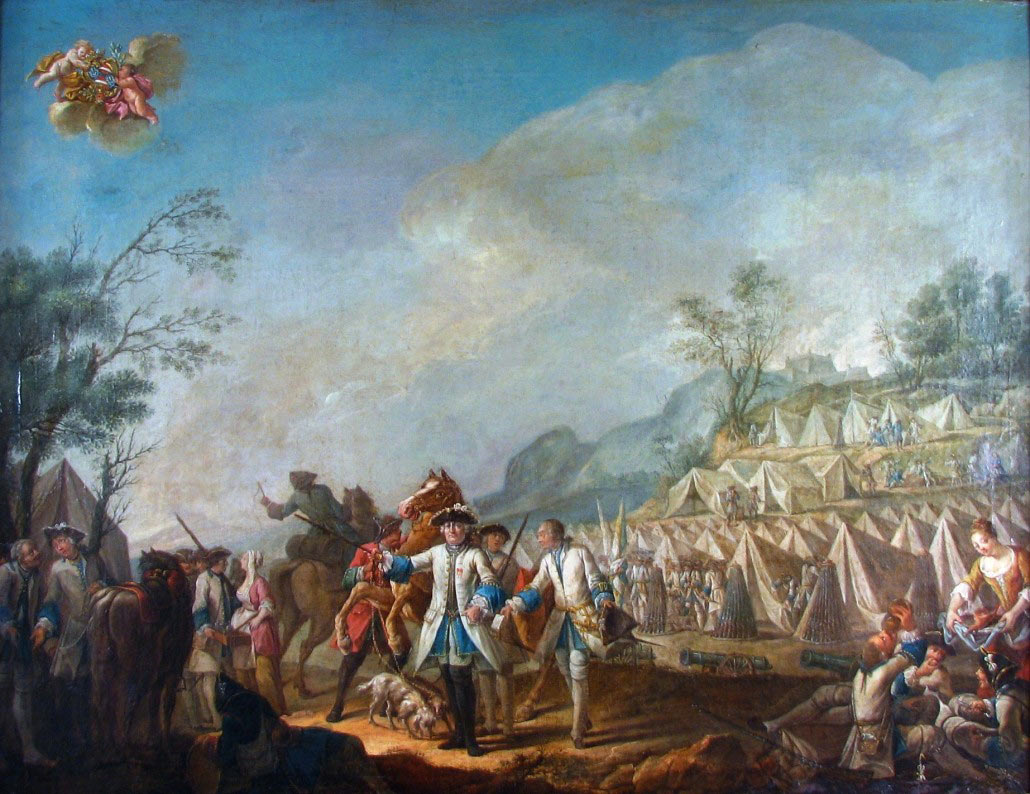
French camp at Fort Ticonderoga: Battle of Ticonderoga on 8th July 1758 in the French and Indian War
Winner of the Battle of Ticonderoga: the French drove back the British/American attack, inflicting heavy losses.
British Regiments at the Battle of Ticonderoga: 27th, 42nd (the Highland Regiment: Black Watch), 44th, 46th, 55th, 1st/ 60th, 4th/60th, Gage’s 80th Light Infantry, Roger’s Rangers and regiments from New York, Massachusetts, Rhode Island, Connecticut, New Jersey and Rhode Island.
27th: Later the Inniskilling Fusiliers and now the Royal Irish Regiment
42nd: The Royal Highland Regiment (the Black Watch)
44th: The Essex Regiment and now the Royal Anglian Regiment
46th: 2nd Bn, the Duke of Cornwall’s Light Infantry and now 1st Bn, the Light Infantry
55th: 2nd Bn, the Border Regiment and now 1st Bn, the King’s Own Royal Border Regiment
60th: The King’s Royal Rifle Corps and now 2nd Bn, the Royal Green Jackets
80th: disbanded
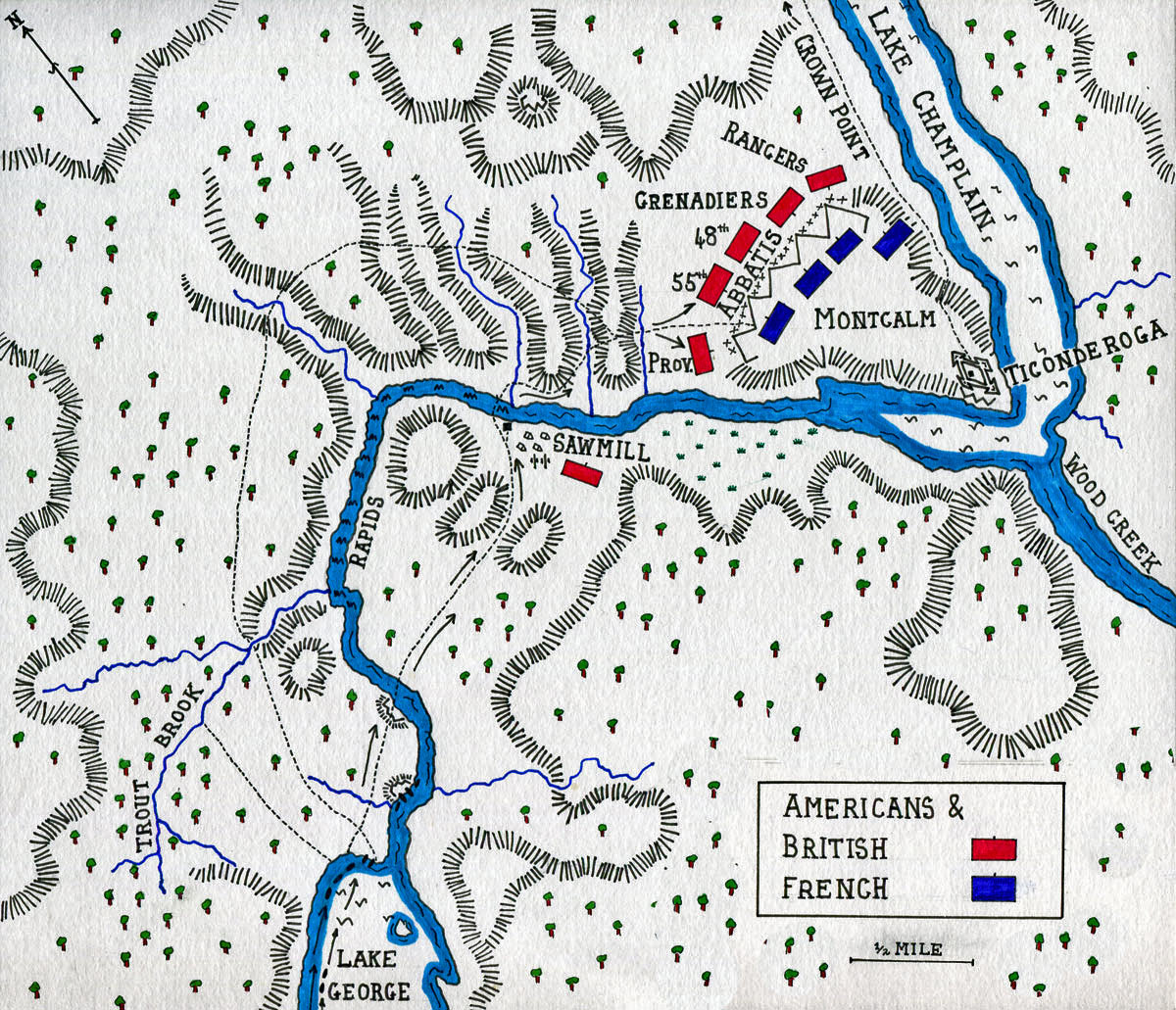
Map of the Battle of Ticonderoga on 8th July 1758 in the French and Indian War: map by John Fawkes
Account of the Battle of Ticonderoga: The French fort of Ticonderoga lay at the southern end of Lake Champlain, part of the long inland waterway that was the main route for a British land invasion of French Canada. In June 1758 a force of British regular and American provincial troops from Massachusetts, New Hampshire and the other New England provinces, in all 15,000 men gathered at the head of Lake George. The nominal commander was General James Abercrombie, an elderly portly man raised to high command through political influence lacking military experience or ability. The true inspiration for the army was Brigadier Lord Howe. Howe understood the nature of warfare in America and worked hard to adapt the troops for forest operations.
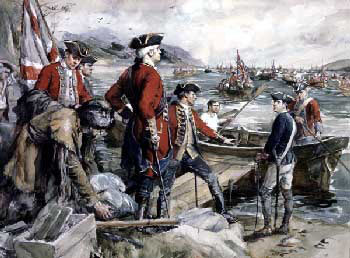
General Abercromby’s force embarking for the attack on Fort Ticonderoga 8th July 1758 in the French and Indian War
The northern tip of Lake George was joined to the southern end of Lake Champlain by a 5 mile strip of river marked by rapids and morass. The French fort stood at the point where the river entered Lake Champlain. Moncalm’s regular French battalions were positioned at various points along the river, the regiment of Berry at the fort, the main party at the Saw Mills further south and an advanced party at the southern end of the portage that bypassed the rapids. Uncertain where to contest the British advance Montcalm ordered the Berry regiment to build a fortified abattis in front of the fort. On 5th July 1758 the British and American flotilla set sail up Lake George, Rogers Rangers and Gage’s light infantry leading.
Arriving at the northern end of Lake George, Howe, Rogers and Bradstreet landed to reconnoitre the French positions. A small French party had been watching the army from the Western bank of Lake George.
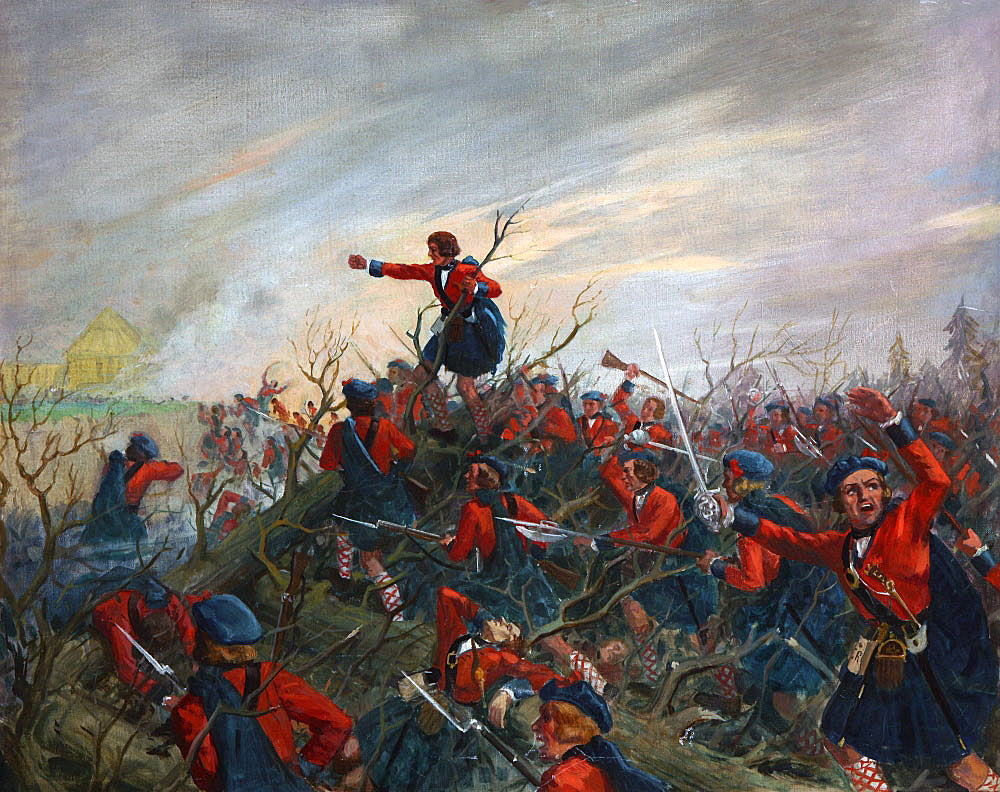
Black Watch, the 42nd Highlanders at the Battle of Ticonderoga on 8th July 1758 in the French and Indian War
In attempting to return to the main camp this force became involved in a fight with the British advanced parties. In the skirmish Howe was killed. The disastrous consequence of Howe’s death was that actual command now fell on the inadequate Abercrombie.
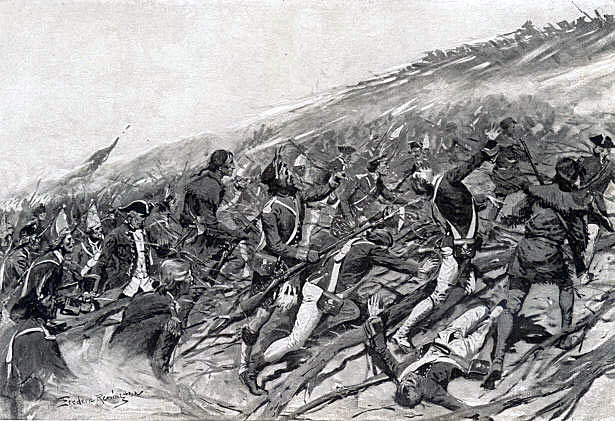
British attack at the Battle of Ticonderoga on 8th July 1758 in the French and Indian War
Initially uncertain how to deal with the assault, Montcalm’s force withdrew behind the abattis constructed across the isthmus on which the fort lay. Montcalm set his whole force to strengthening the position, overnight building a near impenetrable thicket of branches and thorn. After an initial hesitation, Abercrombie resolved to attack, urged on by Bradstreet. Lieutenant Clarke, the army’s engineer was sent to reconnoitre the French position. Clarke advised that the abattis could be stormed by infantry assault.
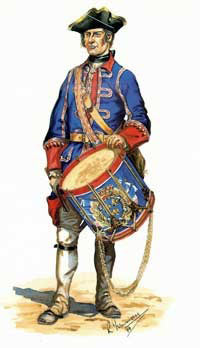
Drummer of the French Royal Roussillon Regiment: Battle of Ticonderoga on 8th July 1758 in the French and Indian War
Behind the fortified line, now reinforced through the arrival of a force commanded by Levis, stood the French regiments of La Sarre, Languedoc, Berry, Royal Rousillon, La Reine, Bearn and Guienne.
Soon after 9am on 8th July the British and Americans began their frontal assault on the abbatis. No use was made of the strong British artillery. The attack continued throughout the day with additional attempts to pass the fort by boat. In spite of the intrepid efforts of the American provincial and the British regular troops the French held them back until finally Abercrombie drew his men off and the retreat began. The attacking troops suffered heavy casualties.
In the final stages of the assault the 42nd Highlanders launched from the reserve a particularly determined attack that came near to succeeding.
Montcalm understandably claimed that he had inflicted a crushing victory on the British.
Casualties at the Battle of Ticonderoga: The American provincials lost 350 killed and wounded. The British battalions lost 1,600 killed and wounded. The worst affected were the 42nd with 490 casualties, 44th and 46th with 200 each, 55th and 4/60th with 150, 1/60th and 27th with 100.
The French casualties were around 350 killed and wounded.
Follow-up to the Battle of Ticonderoga: Abercromby was reduced to a state of panic by his defeat and retreated to the southern end of Lake George. Fortunately some of his subordinates were made of sterner stuff, in particular Bradstreet and Forbes. In August 1758 Bradstreet marched to Fort Frontenac, captured and destroyed the fort and the French flotilla on Lake Ontario. In November Forbes took Fort DuQuesne, Braddock’s nemesis.
Abercromby was withdrawn and his position as commander in chief taken by General Amherst. The French victory deferred their loss of Canada by a year.
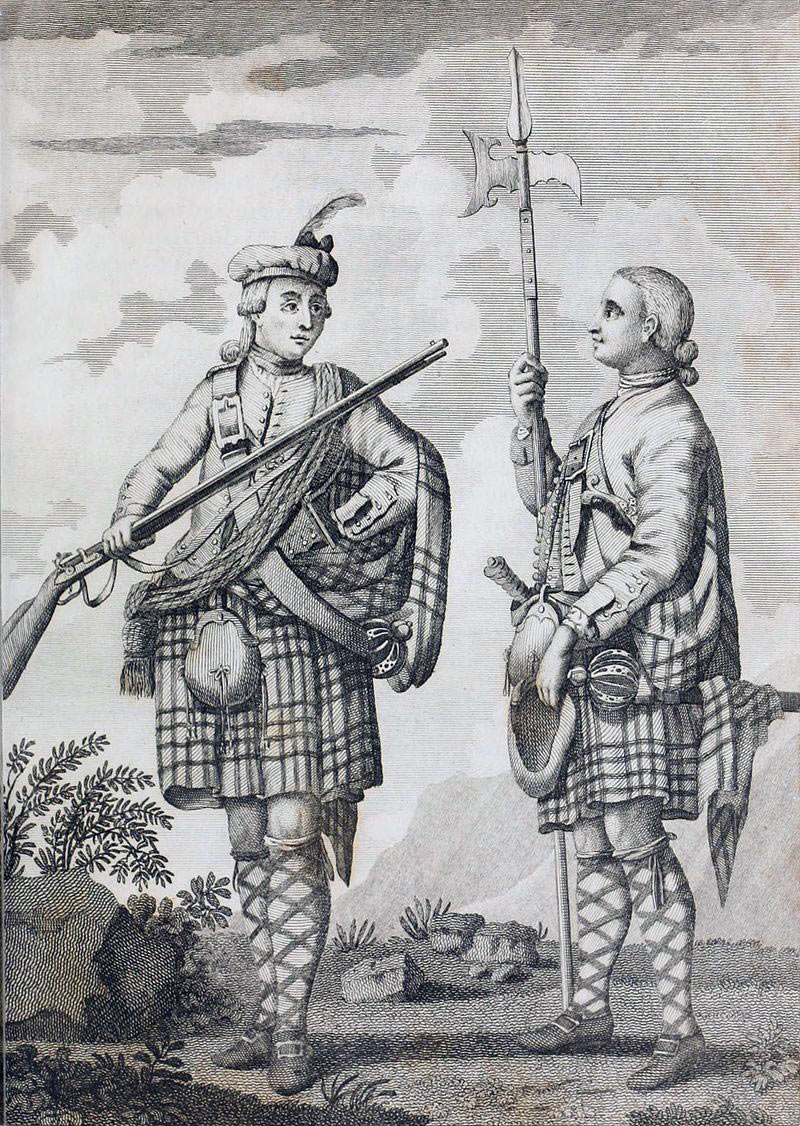
Officer and Sergeant of 42nd Black Watch: Battle of Ticonderoga on 8th July 1758 in the French and Indian War
Anecdotes and traditions from the Battle of Ticonderoga:
- The 42nd is rich in tradition from the battle. Foremost is the account surrounding the death of the regiment’s major, Duncan Campbell of Inverawe. The 42nd was a Campbell regiment. All 5 officer casualties at Fontenoy in 1745 had been Campbells. At some time in the 1740s Inverawe had been involved in concealing a fugitive. When it turned out the man had murdered his cousin, Inverawe turned him out in breach of a promise he had made. The fugitive appeared in a dream to Inverawe and said “I will see you at Ticonderoga”. By 1758 Inverawe had served in the Black Watch for some 20 years and was the major. Only on his arrival in America did he discover the existence of Ticonderoga. The fugitive appeared again to Inverawe in a dream the night before the battle the bloodstained figure predicted his death. Inverawe was severely wounded in the battle and died at Fort Edward after his arm had been amputated.
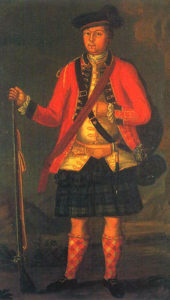
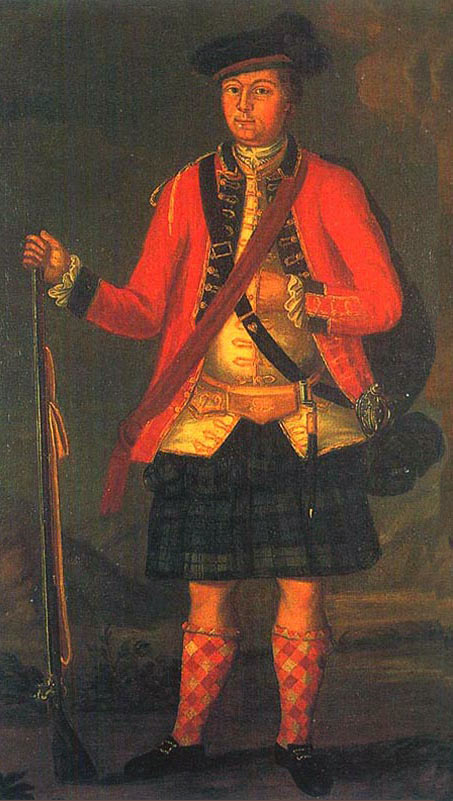
Captain John Campbell: Battle of Ticonderoga on 8th July 1758 in the French and Indian War
- Captain John Campbell who was wounded in the battle is reputed to have been one of the 3 highlanders inspected by George II in 1742 when the regiment marched to London. The King gave each man a sovereign which they are reputed to have thrown to the doorman on the way out.
- Parkman records the bravery of William Smith of the Rhode Island Regiment who fought his way up to the rampart and shot several French soldiers before being severely wounded.
- The 44th suffered heavy casualties in the battle and must be taken to have redeemed itself after Prestonpans and the Monongahela.
References for the Battle of Ticonderoga:
- Ticonderoga 1758 by Rene Chartrand, Osprey Publishing 2000.
- Fort Ticonderoga: Key to a Continent by EP Hamilton.
- Montcalm and Wolfe by Parkman Vol 1 MacMillan 1899
- History of the British Army by Fortescue
The previous battle of the French and Indian War is General Braddock’s defeat in 1755 Part 11
The next battle of the French and Indian War is the Capture of Louisburg
To the French and Indian War index