The savage ‘All American’ battle on 7th October 1780, where the only Englishman present was the loyalist commander, Major Patrick Ferguson
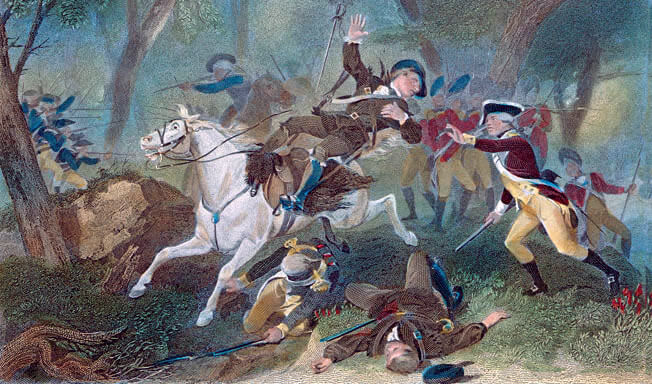
Major Patrick Ferguson falls shot at the Battle of King’s Mountain on 7th October 1780 in the American Revolutionary War
The previous battle of the American Revolutionary War is the Battle of Camden
The next battle of the American Revolutionary War is the Battle of Cowpens
To the American Revolutionary War index
Battle: King’s Mountain
War: American Revolutionary War
Date of the Battle of King’s Mountain: 7th October 1780
Place of the Battle of King’s Mountain: South Carolina, United States of America.
Combatants at the Battle of King’s Mountain:
Tory or Loyalist Americans against Whig or Patriot American Revolutionaries.
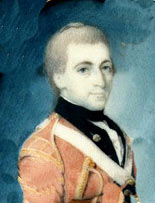
Patrick Ferguson as captain of the light company of the 70th Regiment of Foot: Battle of King’s Mountain on 7th October 1780 in the American Revolutionary War
Commanders at the Battle of King’s Mountain:
The British officer Major Patrick Ferguson commanded the loyalists. There were several officers of the same rank in the American force: Colonels Shelby, Campbell, McDowell, Sevier, Williams, Lacey, Cleveland, Hambright and Winston.
Size of the armies at the Battle of King’s Mountain:
Numbers are uncertain, but there seem to have been around 1,000 on each side.
Uniforms, arms and equipment at the Battle of King’s Mountain:
The soldiers in these opposing forces were “irregulars” and, as such, dressed as they felt inclined. The many Revolutionaries from the frontier areas would have dressed as for a hunting expedition.
The Tory militia was issued with muskets and bayonets and may have worn red uniform coats, but probably wore civilian garb. The Revolutionaries brought with them their hunting weapons, in many cases small bore rifled muskets made by the German gunsmiths of Pennsylvania, which they used with devastating effect on the Tories.
Winner of the Battle of King’s Mountain: Resoundingly the American Revolutionaries. The loyalist force was annihilated.
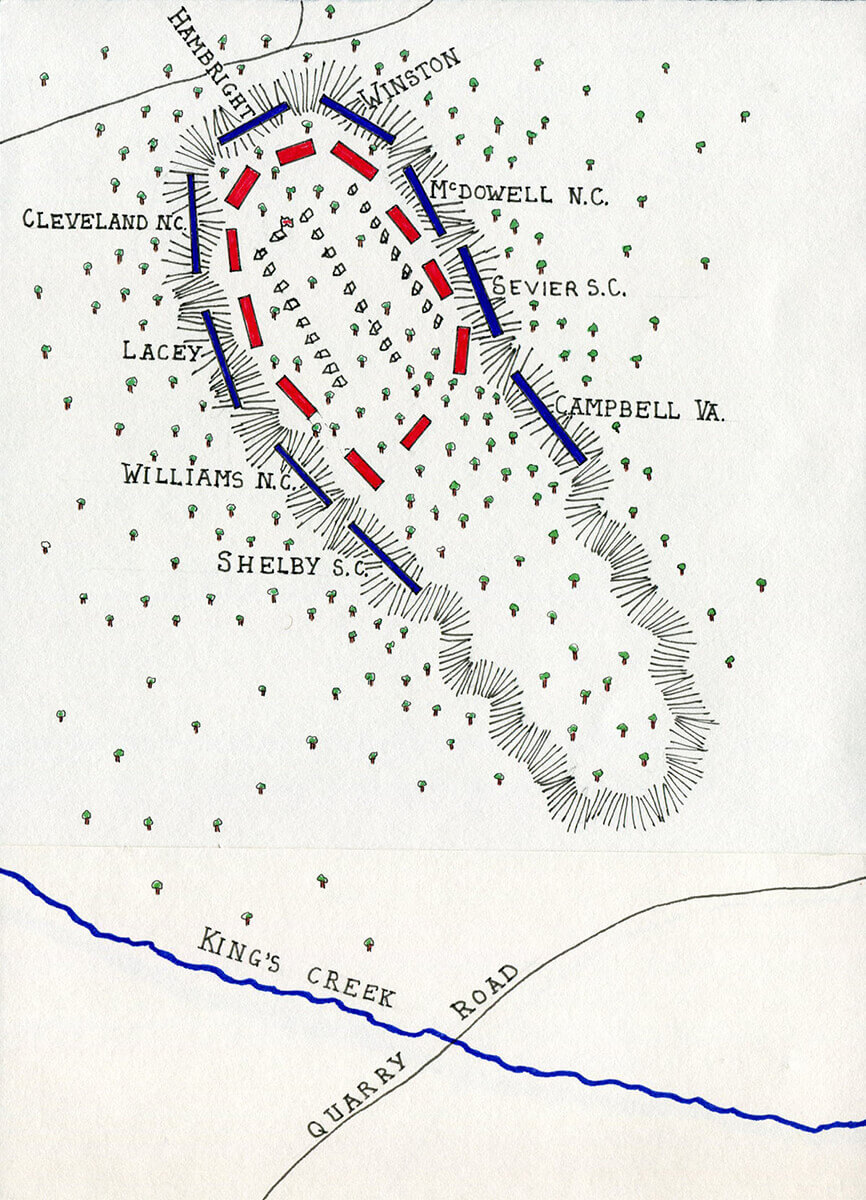
Map of the Battle of King’s Mountain on 7th October 1780 in the American Revolutionary War: map by John Fawkes
Account of the Battle of King’s Mountain:
In September 1780, Major-General Lord Cornwallis, after beating Major-General Gates and the American Revolutionary army at the Battle of Camden in South Carolina, advanced north with the intention of invading North Carolina and Virginia.
Major Ferguson occupied an outpost well to the west of the main British army, with a small force of his own riflemen and a larger band of Tory militia. The militia on each side remained consistently unreliable in battle during the war. The one area in which the Tory militia excelled was in plundering their enemies. Ferguson built for himself an unenviable reputation for ferocity against the rebels.
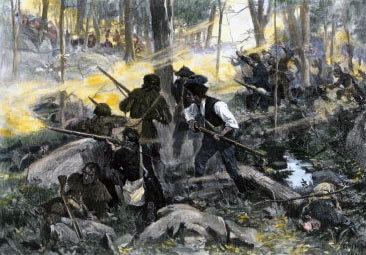
Battle of King’s Mountain on 7th October 1780 in the American Revolutionary War: picture by Frederick Coffay Yohn
A substantial American Revolutionary force gathered against Ferguson; the “over mountain men” from Watauga and men from South Carolina, North Carolina and Virginia. Many of these men were armed with rifled muskets, which they carried all the time and used with considerable skill.
Ferguson retreated before this concentration, sending to Cornwallis for support.
The American force caught up with Ferguson, encamped on the steep and wooded King’s Mountain, on 7th October 1780.
The Revolutionaries surrounded the Tories on the top of the mountain and a straight battle between bayonet and rifle ensued. The Revolutionaries attacked with the battle cry of ‘Tarleton quarter’. The Tory militiamen, attempting to drive back the assaulting Revolutionaries at the point of the bayonet, were shot down or driven back, until the survivors were huddled in a group on the summit.
Ferguson suppressed all attempts to surrender, until he was shot from his horse and killed. The Tories threw down their weapons, but the Revolutionaries continued to shoot, despite the efforts of their officers to bring about an end to the carnage. The battle reflected the savagery of the war in the southern colonies. Finally, all the Tories were killed, wounded or captured. Only a party that had been out foraging escaped to warn Cornwallis of the disaster.
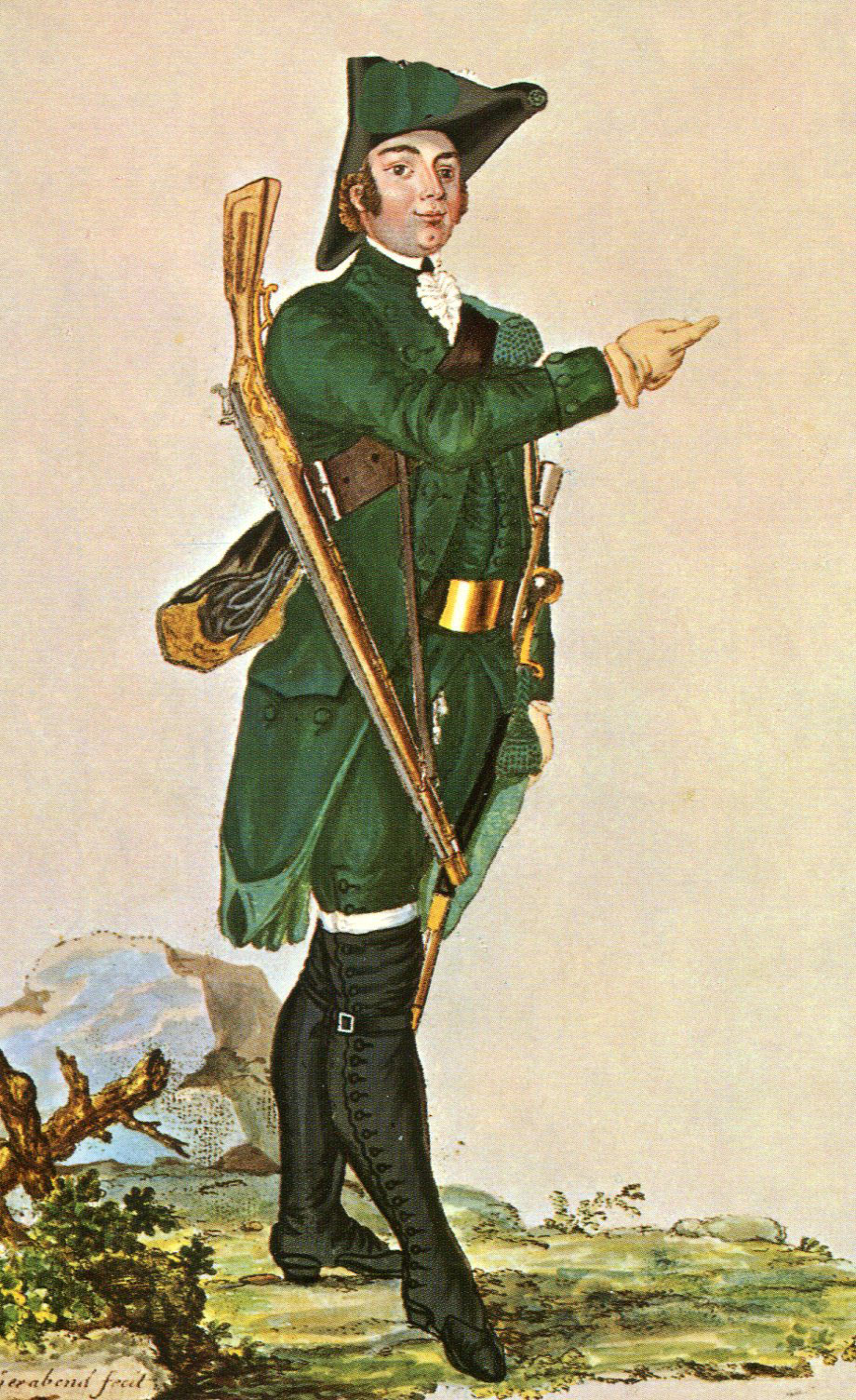
Ferguson’s Light Infantry: Battle of King’s Mountain on 7th October 1780 in the American Revolutionary War
Casualties at the Battle of King’s Mountain:
The Tories suffered 300 dead and wounded and some 700 captured. The Revolutionaries suffered 90 casualties, killed and wounded.
Follow-up to the Battle of King’s Mountain:
The defeat forced Cornwallis to abandon his plans to invade North Carolina, instead he retreated south.
Anecdotes and traditions from the Battle of King’s Mountain:
- This was a battle between Americans, the only Britain present being Major Patrick Ferguson. It would be hard to envisage a more savage encounter. King’s Mountain would be an apter candidate for the title of “massacre” than the Battle of Paoli. Following the Battle of King’s Mountain, the American Revolutionaries tried and hanged ten Tory prisoners for offences of pillaging.
- The American cry of ‘Tarleton quarter’, was a reference to the way the British Colonel Banastre Tarleton conducted his operations, that is without mercy. ‘Tarleton quarter’ meant ‘No prisoners’.
- The ‘over mountain men’ came from the frontier settlements to the west of the Appalachian Mountains. Their communities had a long history of conflict with the British authorities, who attempted to restrict colonist settlement in the areas beyond the mountains occupied by the Cherokee Indians. Once the American Revolutionary War broke out the ‘over mountain men’ were natural revolutionaries.
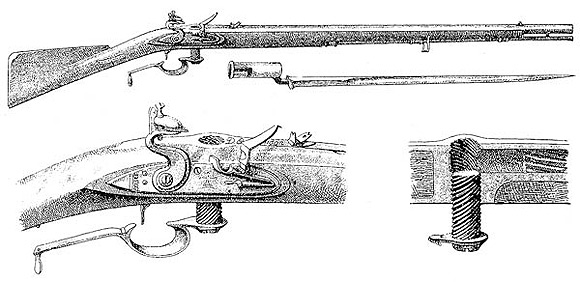
Mechanism of Ferguson’s rifle: Battle of King’s Mountain on 7th October 1780 in the American Revolutionary War
- Patrick Ferguson, a Scottish gentleman, began his active military career as an officer in the Royal Scots Greys, fighting in Europe during the Seven Years War. After the war, Ferguson transferred to the 70th Regiment and served in the West Indies, where he bought a sugar plantation for his family. On his return to England, Ferguson took command of the regiment’s new light company. In 1775, Ferguson began the design of the Ferguson rifle, taken up by the East India Company and the British Army. In 1777, Ferguson raised and trained a corps of light infantry, which he took to America in May 1777. The corps fought in New Jersey and Pennsylvania. Ferguson was severely wounded in the arm at the Battle of Brandywine. On his partial recovery, Ferguson served on the Hudson River and finally at Charleston and in South Carolina, leading loyalist militia, before meeting his death at the Battle of King’s Mountain.
References for the Battle of King’s Mountain:
History of the British Army by Sir John Fortescue
The War of the Revolution by Christopher Ward
The American Revolution by Brendan Morrissey
The previous battle of the American Revolutionary War is the Battle of Camden
The next battle of the American Revolutionary War is the Battle of Cowpens
To the American Revolutionary War index