The Archduke Ferdinand of Brunswick’s resounding defeat of the French fought on 15th July 1761
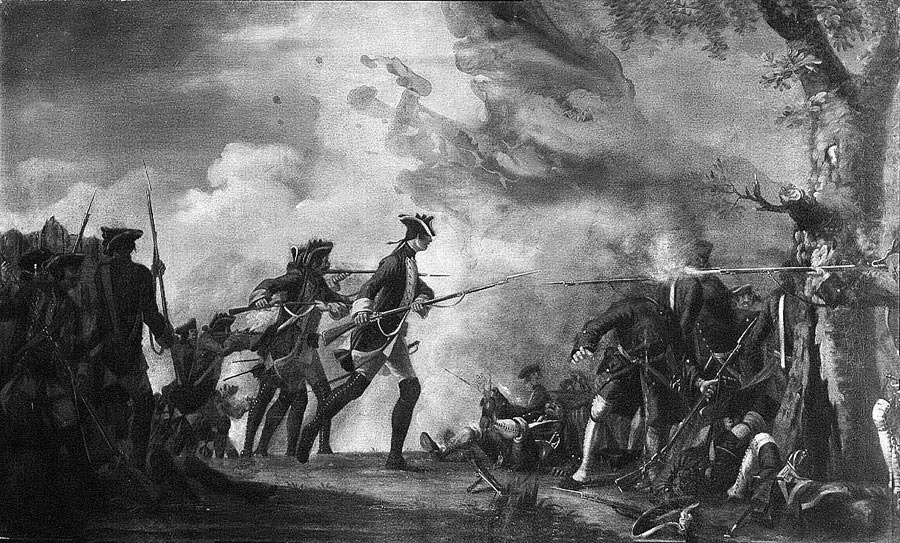
Battle of Vellinghausen on 15th July 1761 in the Seven Years War
The previous battle of the Seven Years War is the Battle of Kloster Kamp
The next battle of the Seven Years War is the Battle of Wilhelmstahl
Battle: Vellinghausen
War: Seven Years War
Date of the Battle of Vellinghausen: 15th July 1761
Place of the Battle of Vellinghausen: On the banks of the Lippe River in North West Germany.
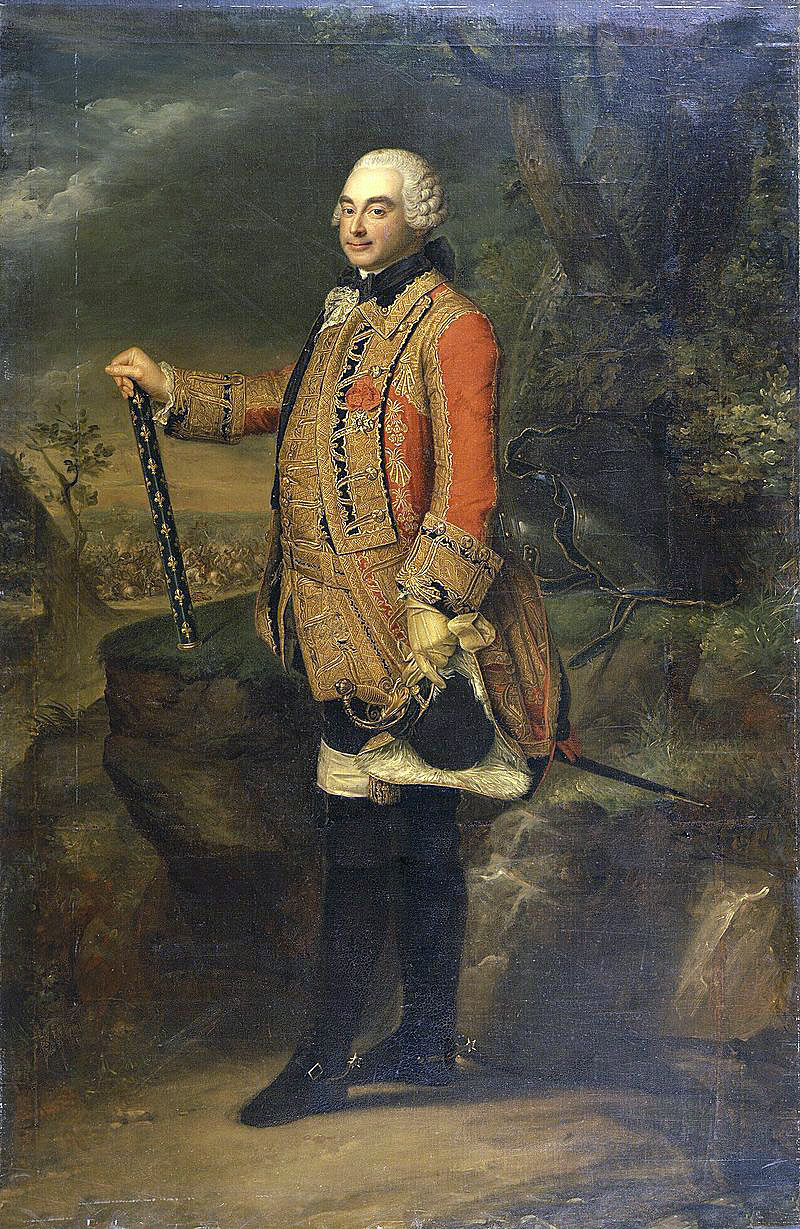
Prince Soubise, French commander at the Battle of Vellinghausen on 15th July 1761 in the Seven Years War
Combatants at the Battle of Vellinghausen: 65,000 British, Hanoverians, Prussians, Brunswickers and Hessians against 92,000 French.
Generals at the Battle of Vellinghausen: The Archduke Ferdinand of Brunswick commanding the allies against Prince Soubise and the Duc de Broglie commanding the French army.
Uniforms, arms and equipment at the Battle of Vellinghausen: All regular European soldiers of this time fought in a knee length uniform coat, turned back at the skirt, cuffs and lapels to reveal a distinctive regimental lining colour. Headgear was a black tricorne hat with a lace brim, except for grenadiers who wore a tall mitre cap. In some armies the grenadier mitre was giving way to a bearskin cap.
The uniform was white for the majority of French regiments, blue for the Prussians and German armies that followed the Prussian tradition, like Hesse-Darmstadt, and red for the British and Hanoverians. There were exceptions within every army. The French Royal Household troops wore a variety of coats. The foreign mercenary regiments in the French service wore red. The Hanoverian and Hessen horse wore white. The British Royal Artillery and Royal Horse Guards wore blue coats.
Winner of the Battle of Vellinghausen: The Archduke Ferdinand of Brunswick.
British Regiments at the Battle of Vellinghausen:
The Royal Horse Guards; now the Blues and Royals.
The King’s Dragoon Guards; now the Queen’s Dragoon Guards.
2nd Dragoon Guards; later the Queen’s Bays and now the Queen’s Dragoon Guards.
3rd Dragoon Guards; later the 3rd Carabineers and now the Royal Scots Dragoon Guards.
The Carabineers; later the 3rd Carabineers and now the Royal Scots Dragoon Guards.
7th Dragoon Guards; later the 4th/7th Royal Dragoon Guards and now the Royal Dragoon Guards.
1st Royal Dragoons; now the Blues and Royals.
6th Inniskilling Dragoons; later the 5th Inniskilling Dragoon Guars and now the Royal Dragoon Guards.
2nd Dragoons, the Royal Scots Greys; now the Royal Scots Dragoon Guards.
7th Dragoons; later the Queen’s Own Hussars and now the Queen’s Royal Hussars.
10th Dragoons; later the Royal Hussars and now the King’s Royal Hussars.
11th Dragoons; later the Royal Hussars and now the King’s Royal Hussars.
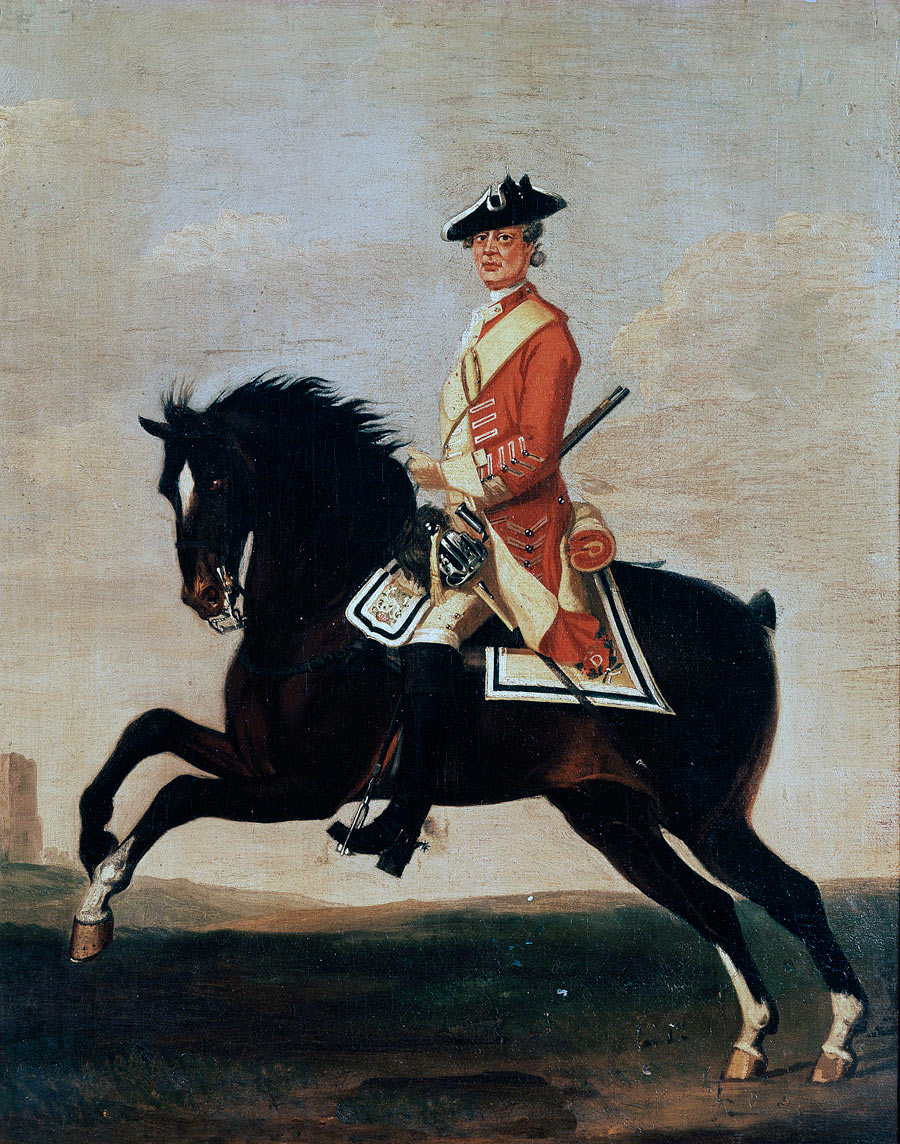
Private 11th Dragoons: Battle of Vellinghausen on 15th July 1761 in the Seven Years War: picture by David Morier
15th Light Dragoons; later the 15th/19th the King’s Royal Hussars and now the Light Dragoons.
Royal Artillery.
2nd Battalion the First Guards, now the Grenadier Guards.
2nd Battalion the Coldstream Guards.
2nd Battalion the Third Guards, now the Scots Guards.
5th Foot; later the Northumberland Fusiliers and now the Royal Regiment of Fusiliers.
8th Foot; The King’s Regiment.
11th Foot; later the Devonshire Regiment and now the Devon and Dorset Regiment.
12th Foot; later the Suffolk Regiment and now the Royal Anglian Regiment.
20th Foot; later the Lancashire Fusiliers and now the Royal Regiment of Fusiliers.
23rd Foot, the Royal Welch Fusiliers.
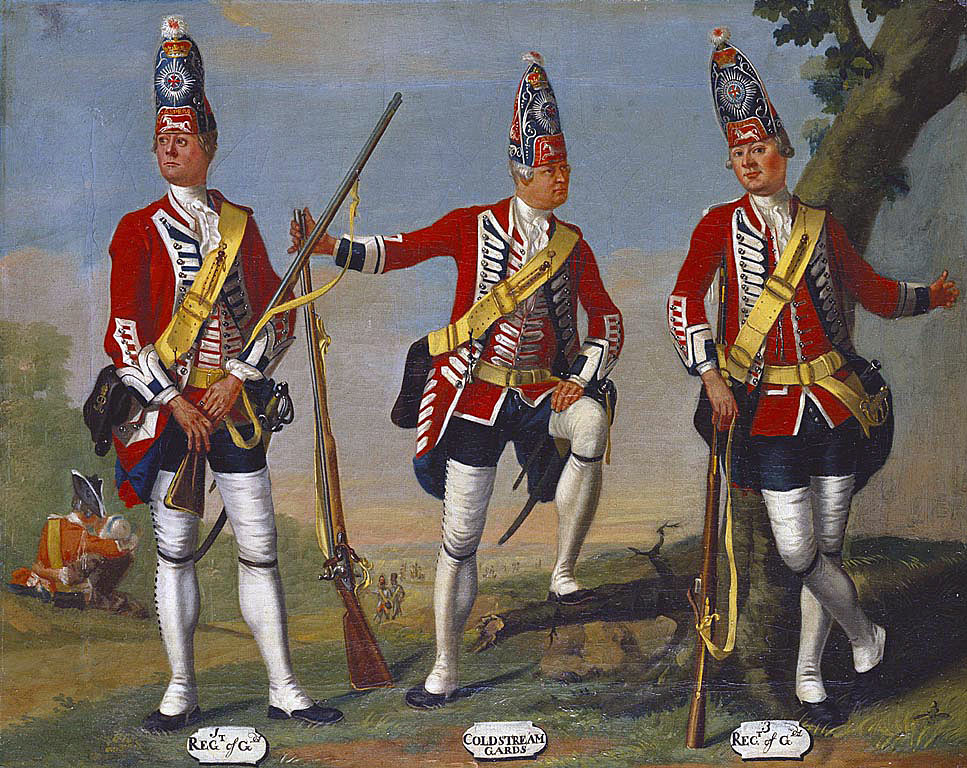
Grenadiers of 1st, Coldstream and 3rd Regiments of Foot Guards: Battle of Vellinghausen on 15th July 1761 in the Seven Years War: picture by David Morier
24th Foot; later the South Wales Borderers and now the Royal Regiment of Wales.
25th Foot; now the King’s Own Scottish Borderers.
33rd Foot; now the Duke of Wellington’s Regiment.
37th Foot; later the Royal Hampshire Regiment and now the Princess of Wales’s Royal Regiment.
27th Foot; later the Royal Inniskilling Fusiliers and now the Royal Irish Regiment.
51st Foot; later the King’s Own Yorkshire Light Infantry and now the Light Infantry.
87th Highlanders; disbanded after the war.
88th Highlanders; disbanded after the war.
Vellinghausen is not a British battle honour.
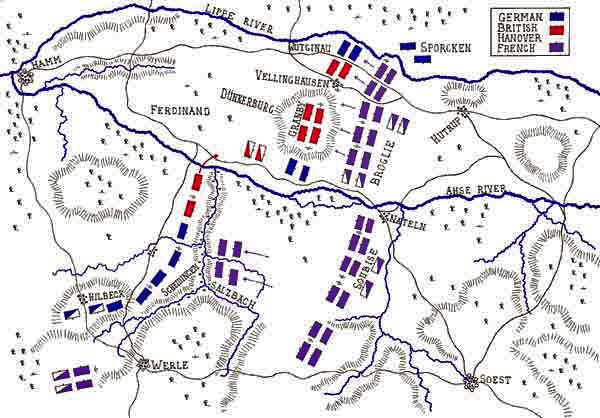
Map of the Battle of Vellinghausen on 15th July 1761 in the Seven Years War: map by John Fawkes
Account of the Battle of Vellinghausen: The main theme of the Seven Years War in North West Germany was the constant French threat to Hanover and the other North Germany states allied to Prussia.
In early July 1761 the two French armies of Prince Soubise and the Duc de Broglie united with the aim of forcing Ferdinand’ army to cross the River Lippe and abandon the important town of Lippstadt. Ferdinand took up positions to the south of the River Lippe while the two French commanders approached him and prepared to attack.
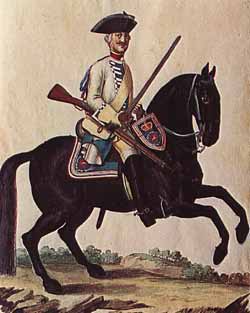
Hanoverian Regiment of Horse von Bremer
The allied army lay along a series of hills stretching from Vellinghausen to Hulbeck, divided in the middle by the Ahse River. The marshy Salzbach Brook lay along the front of the allied right wing.
The French suffered from having in Soubise and Broglie two commanders of equal rank, neither prepared to accept orders from the other. The agreement between them was that Broglie would attack the allied forces that lay between the Ahse and the Lippe Rivers, while Soubise moved against Ferdinand’s troops on the French left, behind Werle, and envelope their unsecured right wing. The attack was intended to begin in the early hours of 16th July 1761.
Broglie’s troops moved forward on the evening of 15th July towards Vellinghausen. The Hessian General Wutginau commanded on the allied left. His corps was encamped to the rear of its intended battle positions and the French advance took his men by surprise. An additional problem was that ammunition was in short supply. The French pressed forward. To take advantage of his unexpected success in what had been intended as a preliminary move, Broglie developed his attack to include the hill above Vellinghausen, the Dünckerburg, held by the Marquis of Granby with British foot and cavalry and some Hanoverian regiments. Although also surprised, the British and German regiments held off the French assault. The fighting continued until nightfall with the French unable to exploit their initial success.

Hanoverian Regiments of Foot
During the night re-inforcements for both sides came into the line. Broglie brought up fresh troops to renew the attack the next day. Ferdinand shifted regiments across the Ahse, strengthening his left wing at the expense of the right, until he reached parity with Broglie. The allied right wing was now heavily outnumbered by Soubise’s army.
At dawn Broglie renewed the attack around Vellinghausen, expecting Soubise to advance on the left wing. In view of the considerable disparity in numbers and that the flank of Ferdinand’s weakened right wing was now badly exposed, the French had a reasonable expectation of victory. But Soubise contented himself with sending a small force out to the left and making a limited assault on the village of Scheidingen, while most of his army remained inactive.
On Broglie’s wing, after some heavy fighting, a fresh allied force under Wolff arrived from the far side of the Lippe and attacked down the left bank of the river, catching the French at a moment of re-organisation and driving them back in confusion. Ferdinand’s left wing, with Brigadier Sandford’s British brigade, the two highland regiments, the British grenadiers and Mannsberg’s Brunswickers, went onto the assault and Broglie’s troops retreated in disorder, one of his regiments being captured.
The battle ended by midday with the French in full retreat.
Casualties: Broglie’s army suffered 4,700 casualties. Soubise lost 300 men. The allies suffered 1,400 casualties. The British casualties in the battle were 434. There were no cavalry casualties on either side.
Follow-up: It seems probable that Ferdinand and his army did not immediately realise they had won the battle. It was a week later that the army was ordered to fire a “feu de joie” to celebrate the victory. This may explain why Ferdinand made no use of his cavalry to follow up the French retreat.
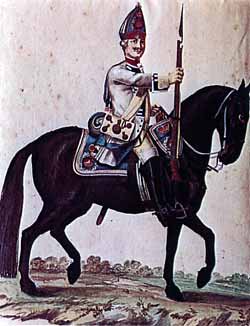
Hanoverian Regiment of Dragoons : Grenadier Troop
The effect of the battle on the French was far reaching. Broglie and Soubise blamed each other for the defeat and refused to co-operate further. They also decided that Ferdinand could not be defeated in battle and that further general engagements were to be avoided.
Anecdotes and traditions of the Battle of Vellinghausen:
- The British surgeons are said to have taken particularly good care of the French wounded in gratitude for the consideration shown to British casualties left on the field of Fontenoy in 1745.
- The Marquess of Granby in a letter reported an incident in the battle in which the Marquis de Rougé was talking with his father-in-law, the Duc d’Havrée, his brother-in-law Lieutenant General the Marquis de Verae and his uncle Lieutenant General Rougé when a cannon ball struck the group killing three of them and taking off the leg of the fourth. It was the Regiment de Rougé that surrendered.
- The British Guards Brigade at the battle was commanded by Major General Julius Caesar.
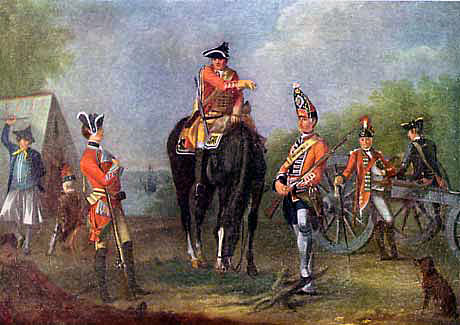
British troops: Battle of Vellinghausen on 15th July 1761 in the Seven Years War
References for the Battle of Vellinghausen:
His Britannic Majesty’s Army in Germany during the Seven Year War by Savory
Fortescue’s History of the British Army
The previous battle of the Seven Years War is the Battle of Kloster Kamp
The next battle of the Seven Years War is the Battle of Wilhelmstahl