The striking victory on 31st July 1760 of the British cavalry led by Lord Granby over the French
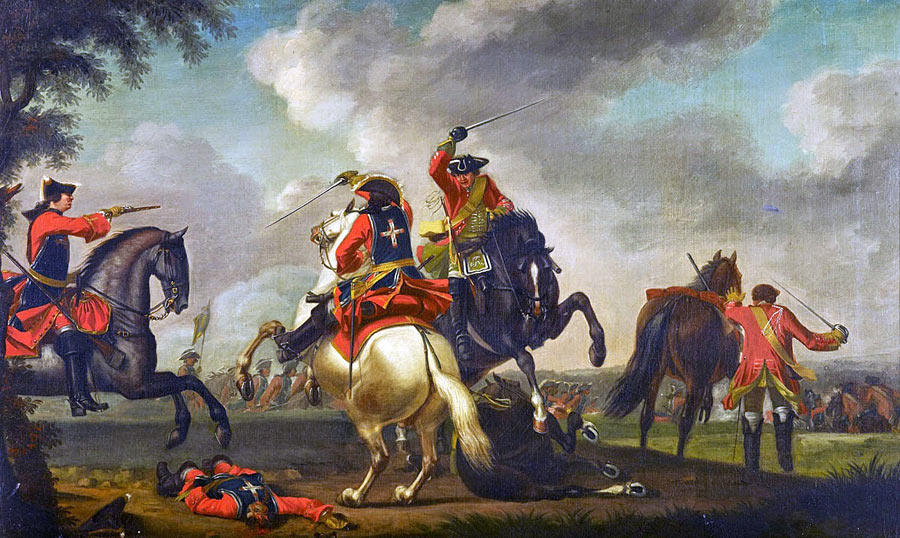
British and French cavalry in combat at the Battle of Warburg on 31st July 1760 during the Seven Years War
The previous battle of the Seven Years War is the Battle of Emsdorf
The next battle of the Seven Years War is the Battle of Kloster Kamp
Battle: Warburg
War: Seven Years War
Date of the Battle of Warburg: 31st July 1760
Place of the Battle of Warburg: North West Germany
Combatants at the Battle of Warburg:
A force of German, Hanoverian and British troops commanded by Prince Ferdinand of Brunswick and the Erbprinz (Hereditary Prince) of Hesse-Kassel, supported by the Marquess of Granby’s force of British cavalry, against a French force commanded by Lieutenant General Le Chevalier du Muy.
Generals at the Battle of Warburg:
Prince Ferdinand of Brunswick and the Erbprinz of Hesse-Kassel against Lieutenant General Le Chevalier du Muy.
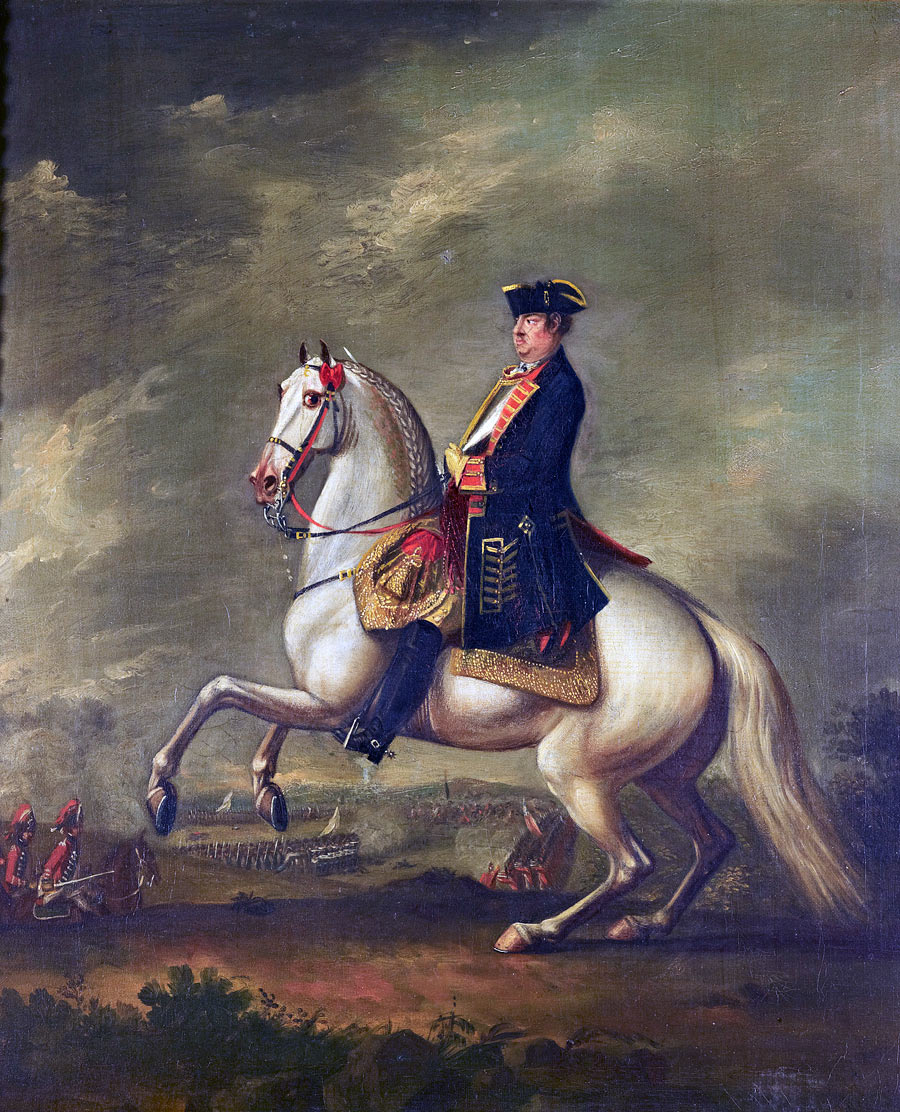
John Manners, Marquis of Granby at the Battle of Warburg on 31st July 1760 during the Seven Years War
Size of the armies at the Battle of Warburg:
Prince Ferdinand’s army numbered 62,000 while the Duc de Broglie’s army numbered 130,000. However the numbers directly in the battle were around 16,000 German and British troops while du Muy had around 20,000 men.
Uniforms, arms and equipment at the Battle of Warburg:
All regular European soldiers of this time fought in a knee length uniform coat, turned back at the skirt, cuffs and lapels to reveal a distinctive regimental lining colour. Headgear was a black tricorne hat with a lace brim, except for grenadiers who wore a tall mitre cap. In some armies the grenadier mitre was giving way to a bearskin cap. The uniform was white for the majority of French regiments, blue for the Prussians and German armies that followed the Prussian tradition, like Hesse-Darmstadt, and red for the British and Hanoverians. There were exceptions within every army. The French Royal Household troops wore a variety of coats. The foreign mercenary regiments in the French service wore red or dark blue. The Hanoverian and Hessen horse wore white. The British Royal Artillery and Royal Horse Guards wore blue coats.
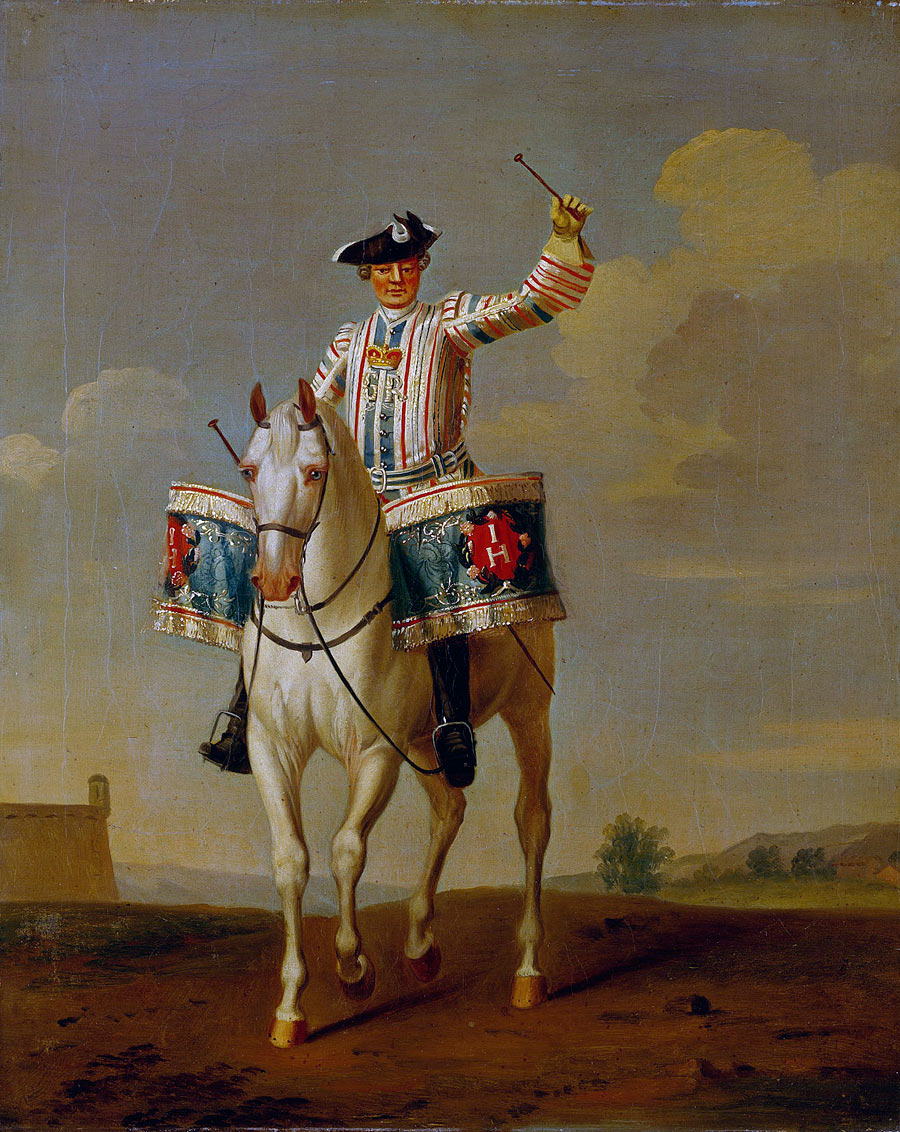
British Kettle Drummer of Horse: Battle of Warburg on 31st July 1760 during the Seven Years War: picture by David Morier
Winner of the Battle of Warburg: Prince Ferdinand with his German and British troops.
British Regiments at the Battle of Warburg:
The Royal Regiment of Horse: later the Royal Horse Guards and now the Blues and Royals *
1st Dragoon Guards, the King’s Dragoon Guards & now the Queen’s Dragoon Guards *
2nd Dragoon Guards, the Queen’s Bays and now the Queen’s Dragoon Guards.*
3rd Dragoon Guards, later the 3rd Carabineers and now the Royal Scots Dragoon Guards.*
6th Dragoon Guards, later the 3rd Carabineers and now the Royal Scots Dragoon Guards.*
7th Dragoon Guards, later the 4th/7th Royal Dragoon Guards and now the Royal Dragoon Guards.*
2nd Royal North British Dragoons, the Scots Greys and now the Royal Scots Dragoon Guards.*
6th Inniskilling Dragoons, later the 5th Inniskilling Dragoon Guards and now the Royal Dragoon Guards.*
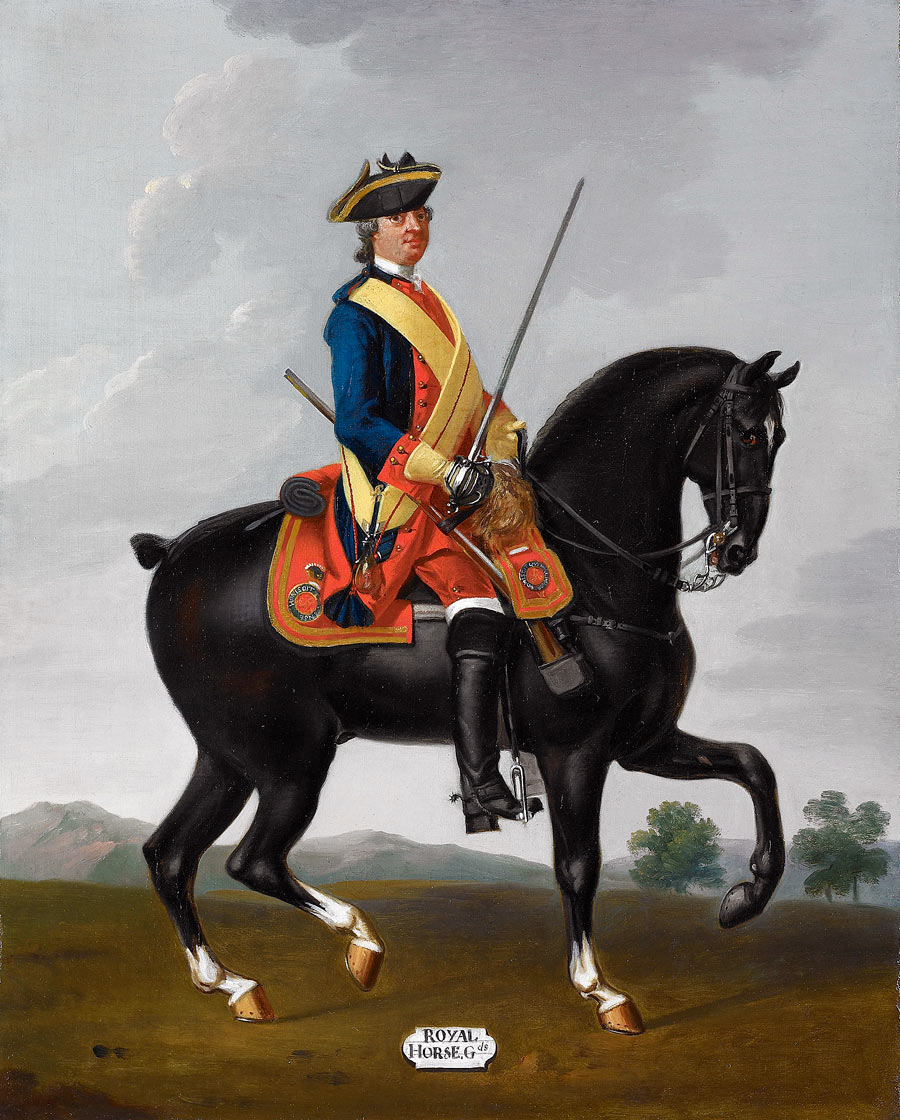
Royal Horse Guards, the ‘Blues’: Battle of Warburg on 31st July 1760 during the Seven Years War: picture by David Morier
10th Dragoons, later the 10th Royal Hussars, then the Royal Hussars and now the King’s Royal Hussars.*
11th Dragoons, later the 11th Hussars, then the Royal Hussars and now the King’s Royal Hussars.*
Royal Artillery:
5th Foot: later the Northumberland Fusiliers and now the Royal Regiment of Fusiliers.
8th King’s Regiment: now the Duke of Lancaster’s Regiment.
11th Foot: later the Devonshire Regiment and now the Rifles
12th Foot: later the Suffolk Regiment and now the Royal Anglian Regiment.
20th Foot: later the Lancashire Fusiliers and now the Royal Regiment of Fusiliers.
23rd Royal Welch Fusiliers now the Royal Welsh
24th Foot: later the South Wales Borderers and now the Royal Welsh
25th Foot, later the King’s Own Scottish Borderers and now the Royal Regiment of Scotland
33rd Foot, later the Duke of Wellington’s Regiment and now the Yorkshire Regiment
50th Foot: later the Queen’s Own Royal West Kent Regiment, then the Queen’s Own Buffs, then the Queen’s Regiment and now the Princess of Wales’s Royal Regiment.
51st Foot: later the King’s Own Yorkshire Light Infantry and now the Light Infantry.
87th Highlanders, Keith’s: disbanded in 1765.
88th Highlanders, Campbell’s disbanded in 1765.
*Awarded Warburg as a battle honour.
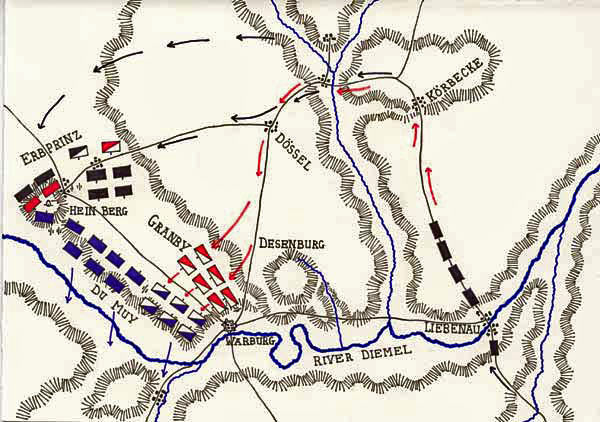
Map of the Battle of Warburg on 31st July 1760 during the Seven Years War: map by John Fawkes
Account of the Battle of Warburg:
In late July 1760 Prince Ferdinand with his Hanoverian, Hessian, British and Prussian troops was forced to retreat north before Broglie’s superior French army, into the triangular area between the Diemel and Weser Rivers. Kassel, lying on the left bank of the Weser, Ferdinand’s main base, was threatened.
Prince Ferdinand ordered a force into Kassel and withdrew the rest of his army into positions to the north of the city. On 27th July 1760 Ferdinand struck camp and moved west towards the Diemel, leaving the garrison in Kassel with orders to withdraw north to Münden if hard pressed.
Broglie saw the move and was concerned to stop Ferdinand crossing the Diemel. He ordered the Chevalier du Muy to cross the river at Marsberg and to march east along the north bank to Warburg. Broglie sent Fischer’s light troops to Warburg to seize the town and its bridges. Fischer occupied Warburg and posted troops on a hill east of the town called the Desenberg.
Ferdinand’s subordinates, Spörcken and Bülow hurried forward and seized the Diemel crossings at Liebenau and Trendelburg. Bülow’s British Legion hussars moved west and drove Fisher’s light troops off the Desenberg.
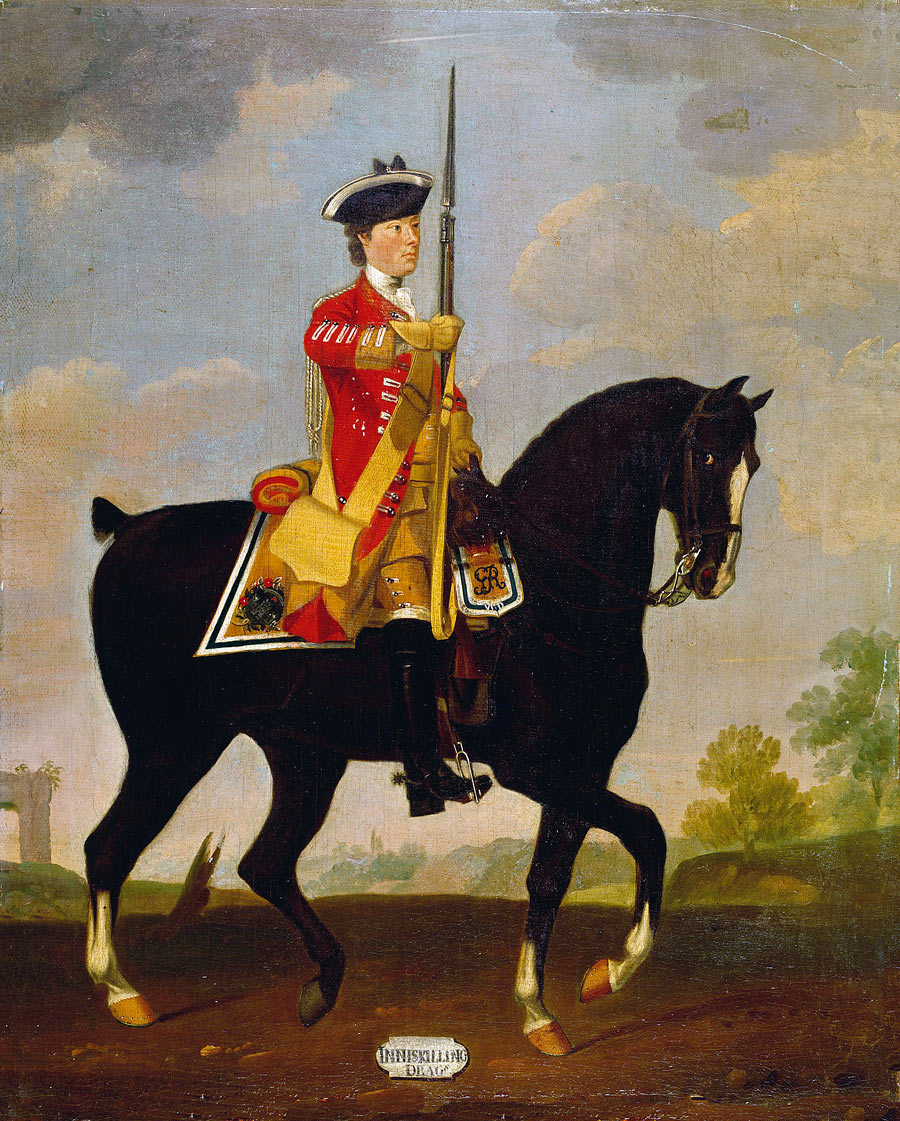
6th Inniskilling Dragoons: Battle of Warburg on 31st July 1760 during the Seven Years War: picture by David Morier
The Erbprinz and Spörcken concentrated at Köbecke to attack du Muy who had occupied a position to the North West of Wargrave parallel with the Diemel River.
The Erbprinz had 22 squadrons of cavalry (including the British Royal Dragoons and 7th Dragoons), 23 battalions of infantry (including 2 battalions of British Grenadiers and the 87th and 88th Highlanders) and 26 guns. Du Muy had 31 squadrons, 28 battalions and 24 guns.
On 30th July 1760, aware of the precariousness of his troops on the far side of the Diemel if Du Muy were reinforced, Ferdinand struck camp and marched for the river crossings.
Meanwhile the Erbprinz reconnoitred du Muy’s position and resolved to attack his force with a wide right flanking move in two columns.
Bülow’s British Legion occupied the Desenberg and demonstrated against du Muy’s front to keep him occupied while the rest of the Erbprinz’s troops executed a night march into its attack positions. The column commanded by Hardenberg would take a hill behind the French left flank called Hein Berg, topped by a tower, while Zastrow’s column, moving inside him, would attack the end of the French line. Ferdinand directed that the Erbprinz’s assault was not to begin until his main army had begun to cross the Diemel and could provide support.
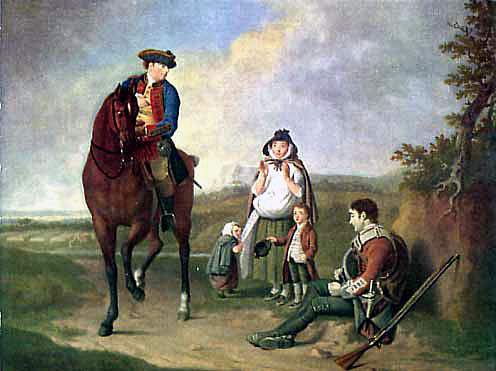
Marquess of Granby relieving a sick soldier: Battle of Warburg on 31st July 1760 during the Seven Years War
The 31st July 1760 dawned with a heavy mist preceding a hot day. At 7am Ferdinand, now present in the forward area, ordered the attack.
The battle began with the French capture of the Desenberg. Severely hampered by the mist, du Muy after some 2 hours made out Ferdinand’s army approaching from the Diemel crossing at Liebenau towards his right front.
Du Muy ordered his troops to form along the ridge behind which they had encamped.
Meanwhile the Erbprinz’s two columns were advancing through the mist behind du Muy’s left flank. At around midday the right column of British Grenadiers, Highlanders and 2 battalions of Hanoverian Grenadiers took the Hein Berg. Taken completely by surprise, Du Muy reacted with a heavy counter attack. Soon afterwards the Erbprinz’s left column launched its assault, taking the French in the rear and over running their guns. After heavy fighting the French line crumbled and was driven off the ridge by a charge from the British Royal Dragoons.
Du Muy’s 31 squadrons of cavalry on the right of his line had not been engaged, when they were attacked by a force of cavalry from their front. The Marquess of Granby and his British cavalry regiments had crossed the Diemel at Liebenau with Prince Ferdinand’s main army and force marched to reach the battle in time to support the Erbprinz. The infantry had been left toiling up behind them. The British regiments’ ferocious charge on the French cavalry caught them in the process of retiring, inflicted considerable loss and drove them across the river with the rest of du Muy’s force.
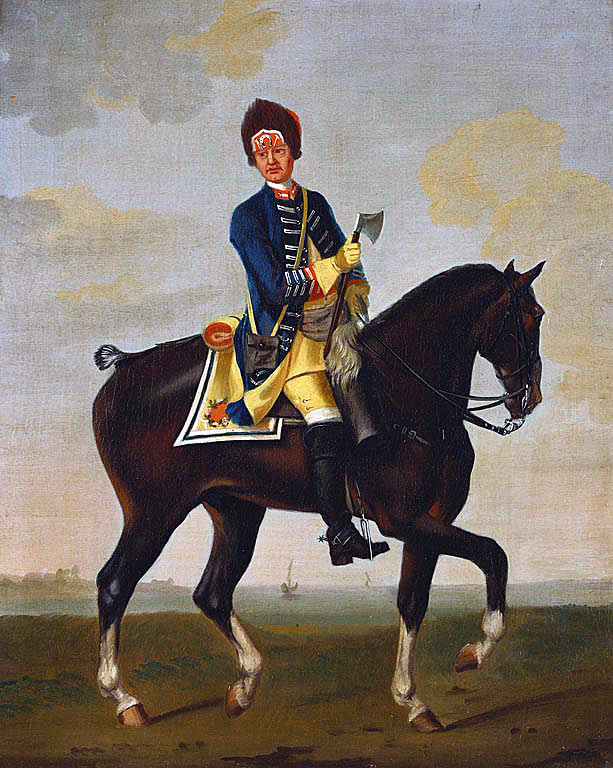
Farrier, 11th Dragoons: Battle of Warburg on 31st July 1760 during the Seven Years War: picture by David Morier
Granby pursued the French cavalry across the river but was forced to retire by the arrival of substantial reinforcements sent by Broglie.
Casualties at the Battle of Warburg:
The French are said to have suffered between 6,000 and 8,000 casualties and to have lost 12 guns. The Germans and British suffered 1,200 casualties of which 240 were from one of the British grenadier battalions. British cavalry losses are described as “trifling”.
Follow-up to the Battle of Warburg:
Although Warburg was a success, Broglie took advantage of the absence of Ferdinand’s army to take Kassel, a considerable blow to Ferdinand’s future campaign plans.
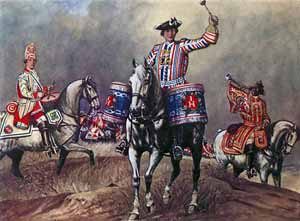
British Cavalry in the Seven Years War: Battle of Warburg on 31st July 1760 during the Seven Years War
Regimental anecdotes and traditions of the Battle of Warburg:
- Warburg is considered one of the great triumphs of British cavalry action. All the mounted regiments have Warburg as a battle honour. Curiously the honour was not awarded to any of the infantry regiments involved, possibly because the British units were composite battalions of grenadiers.
- The Marquess of Granby is said to have lost his hat and wig in the charge, leaving his bald head gleaming in the sun. It is said this is the origin of the expression to “go bald headed” at something.
- Granby was highly popular throughout the army and throughout Britain. Many public houses are named after him. His generosity was legendary.
References for the Battle of Warburg:
His Britannic Majesty’s Army in Germany during the Seven Year War by Savory
Fortescue’s History of the British Army
The previous battle of the Seven Years War is the Battle of Emsdorf
The next battle of the Seven Years War is the Battle of Kloster Kamp