The War of the Austrian Succession, known in America as King George’s War.
The battles of King George’s War/the War of the Austrian Succession:
Battle of Dettingen: The last battle, fought on 16th June 1743, at which a British King was present, King George II: a victory for the Pragmatic Army led, nominally, by King George II.
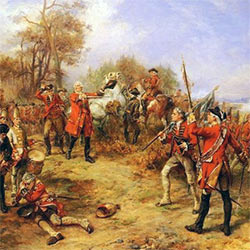
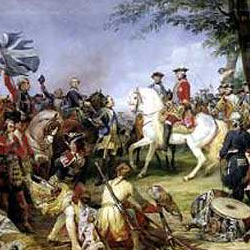
Battle of Fontenoy: The battle on 30th April 1745 that gave the British and Hanoverian infantry a reputation for dogged bravery
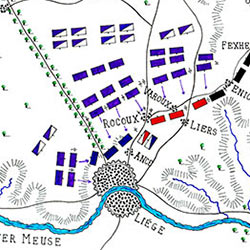
Battle of Rocoux: The battle on 30th September 1746 at which General Ligonier, in command of the British, Hanoverian and Hessian troops, showed his tactical ability in handling an overwhelming attacking force of French troops.
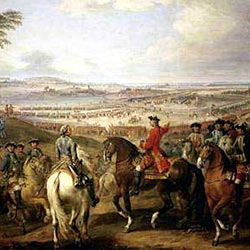
Battle of Lauffeldt: The heavy defeat of the Pragmatic allies on 21st June 1747 that showed up the inadequacies of the Duke of Cumberland’s generalship.
King George’s War/the War of the Austrian Succession:
In 1740 the deaths of two European monarchs plunged the continent into war. Frederick William I, the “sergeant major” King of Prussia, died on 31st May 1740. On his death the Prussian throne passed to his ruthlessly ambitious son, Frederick. With the crown, Frederick inherited the most advanced army in Europe supported by a state bureaucracy of unrivalled efficiency, institutions his father had spent a lifetime perfecting. The opportunity for Frederick, soon to be known as “The Great”, to use these instruments arose with the second death in that year.
Charles VI, Emperor of Austria, died on 19th October 1740, leaving his imperial throne to his daughter Maria Theresa. Charles feared that the powerful states of Europe would upon his death seize chunks of the empire, expecting that his daughter would be unable to defend her inheritance. He had spent the last years of his life devising the Pragmatic Sanction of Prague, a convention that guaranteed the integrity of Maria Theresa’s imperial dominions, and persuading the monarchs of Europe to subscribe to it.
On the death of Charles VI, Frederick tore up Prussia’s commitment to the Pragmatic Sanction and seized Silesia, marching his troops into the capital, Breslau, and annexing the rich Austrian province to Prussia.
If Frederick thought Maria Theresa would acquiesce in this outrage, he was mistaken. She declared war on Prussia and invaded Silesia, precipitating the wars that would rage for a quarter of a century. The conflict did not finally end until the Treaty of Paris in 1764 confirmed Prussia’s ownership of Silesia.
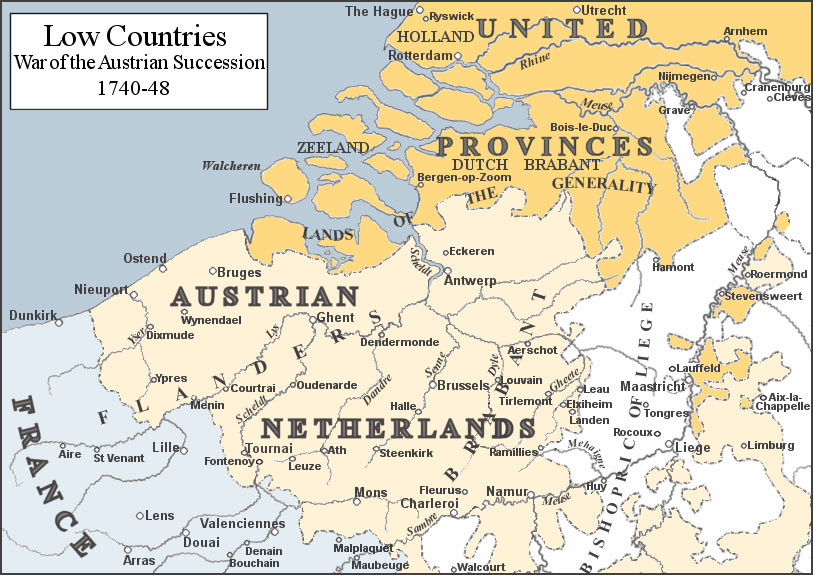
The ‘Low Countries’ in the War of the Austrian Succession 1740 to 1748
The first period of fighting from 1740 to 1748 was known as the “War of the Austrian Succession” or in England as “King George’s War”. Austria and Prussia fought in Silesia and Bohemia while French armies invaded Bavaria. In 1742 the French threatened the Austrian Netherlands, a region ruled by Austria, and the Dutch Republic or the United Provinces. A Pragmatic Army named from Charles VI’s Sanctions assembled to counter the French invasion, with troops from Austria and various German states including Hanover.
George II, King of England and Elector of Hanover, resolved to send English troops to join the Pragmatic Allies. Ostensibly the army was to fight for Maria Theresa, but George’s concern was that the French intended to pass through the Low Countries and invade his beloved Hanover.
The English force was dispatched to Flanders in mid-1742 and remained there until the end of the war in 1748, fighting the four battles of Dettingen, Fontenoy, Rocoux and Lauffeldt. There was one major interlude from late 1745 to 1746, when Prince Charles, the Young Pretender, landed in Scotland and invaded England with a highland army. This adventure, encouraged and resourced by France, brought the Hanoverian Crown to the brink of disaster and was retrieved only when the Flanders regiments returned to Britain and defeated the highlanders at Culloden Moor.
In 1742, England had not fought a European war since the time of the Duke of Marlborough. In the intervening twenty years of peace, the army had been neglected by governments reluctant to spend money on the armed services.
The first British commander in chief was John Dalrymple, Earl of Stair. He was hampered by the refusal of the Dutch, Austrian and British commanders to co-operate in a plan of campaign. An additional embarrassment was George II’s fear of provoking the French to outright war.
In 1743 the Pragmatic Army marched South to the Frankfurt region of Germany. There it was joined by George II and the Battle of Dettingen was fought against the French Army of the Duc de Noailles.
The Pragmatic Army spent 1744 in idleness while the French Army under Marshal Maurice de Saxe overran areas of Flanders.
In early 1745 the young Duke of Cumberland, second and favourite son of George II, became commander in chief of the Pragmatic Army in time to march to the relief of the City of Tournai, under siege by Marshal Saxe in the South West of Flanders. This led to the Battle of Fontenoy.
In September 1745 Britain was rocked by the Jacobite invasion from Scotland led by Prince Charles. Most of the British troops were withdrawn to combat the rebellion.
Only in 1747 did the British troops return in numbers to the Flanders War. The pattern continued of the French under Saxe inexorably overrunning the province. The battles of Roucoux and Lauffeldt were fought and in 1748 peace came, although only as an interlude before the serious bludgeoning of the Seven Years War began in 1755.
Britain used the return of Louisburg, captured by the New England colonists, as the bargaining counter to persuade the French to give up their conquests.
The battles of King George’s War/the War of the Austrian Succession:
Battle of Dettingen: The last battle, fought on 16th June 1743, at which a British King was present, King George II: a victory for the Pragmatic Army led, nominally, by King George II.
Battle of Fontenoy: The battle on 30th April 1745 that gave the British and Hanoverian infantry a reputation for dogged bravery
Battle of Rocoux: The battle on 30th September 1746 at which General Ligonier, in command of the British, Hanoverian and Hessian troops, showed his tactical ability in handling an overwhelming attacking force of French troops.
Battle of Lauffeldt: The heavy defeat of the Pragmatic allies on 21st June 1747 that showed up the inadequacies of the Duke of Cumberland’s generalship.