The battle on 28th October 1776, leading to the American withdrawal to the Delaware River and the capture of Fort Washington by the British
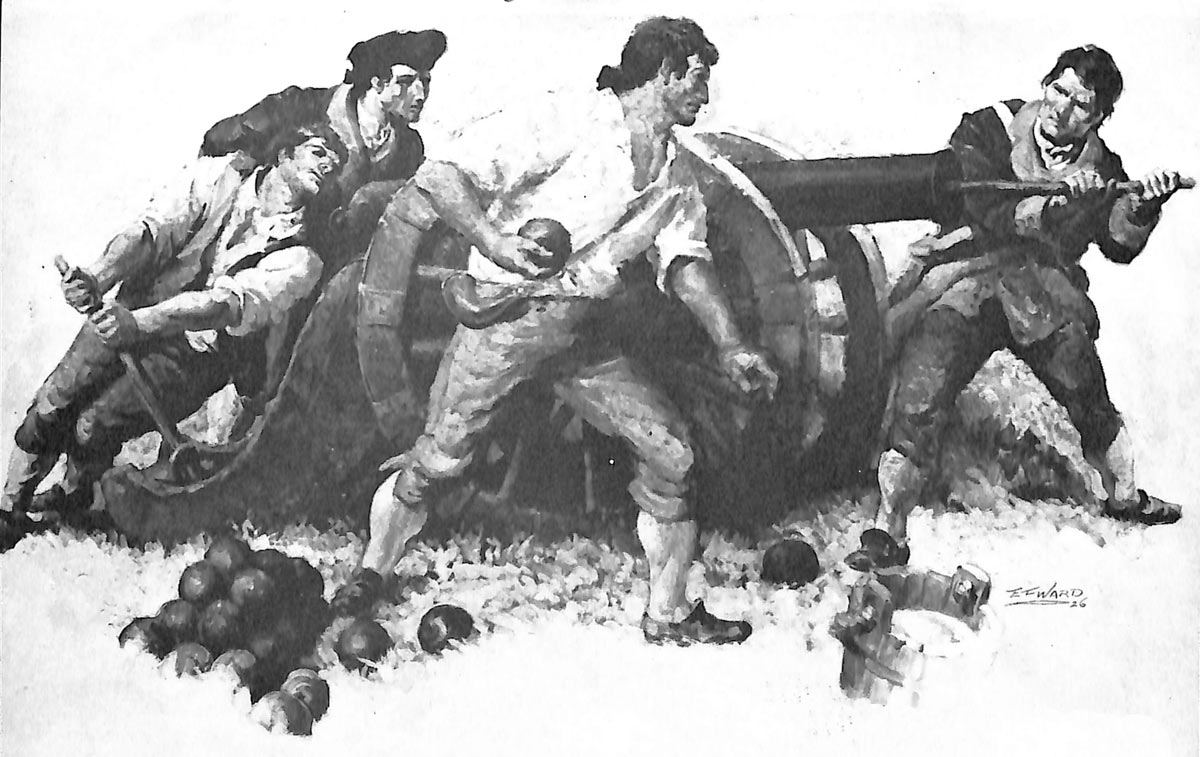
American gunners at the Battle of White Plains on 28th October 1776 in the American Revolutionary War: picture by E.F. Ward
The previous battle of the American Revolutionary War is the Battle of Harlem Heights
The next battle of the American Revolutionary War is the Battle of Fort Washington
To the American Revolutionary War index
Battle: White Plains
War: American Revolutionary War
Date of the Battle of White Plains: 28th October 1776
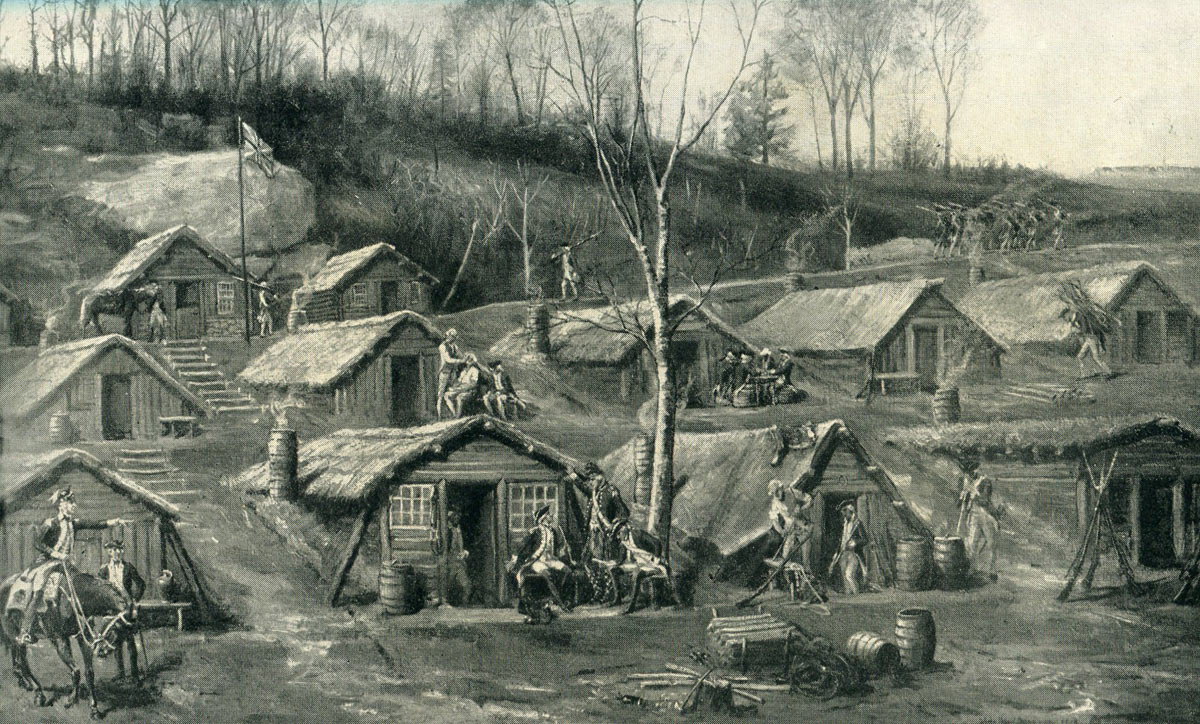
British encampment at Dyckman Farm on Manhattan Island: Battle of White Plains on 28th October 1776 in the American Revolutionary War
Place of the Battle of White Plains: New York State
Combatants at the Battle of White Plains: British against the Americans
Generals at the Battle of White Plains: Lieutenant-General William Howe and General George Washington
Size of the armies at the Battle of White Plains: 13,000 British and German troops against 14,500 Americans, although only around 4,000 on each side were actually engaged.
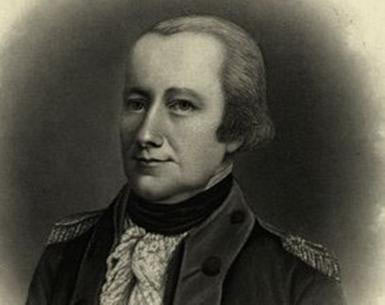
Alexander McDougall commanded 1st New York Regiment at the Battle of White Plains on 28th October 1776 in the American Revolutionary War
Uniforms, arms and equipment at the Battle of Harlem Heights: The British wore red coats, with bearskin caps for the grenadiers, tricorne hats for the battalion companies and caps for the light infantry.
The two regiments of light dragoons that served in America, the 16th and 17th, wore red coats and leather crested helmets.
The German infantry wore blue coats and retained the Prussian style grenadier mitre cap with brass front plate.
The Americans dressed as best they could. Increasingly as the war progressed regular infantry regiments of the Continental Army wore blue uniform coats, but the militia continued in rough clothing.
Both sides were armed with muskets, bayonets and cannons, mostly of small calibre. The Pennsylvania regiments and other men of the woods carried long, small calibre, rifled weapons.
Winner: The Americans were driven back, but were enabled to draw off from the White Plain position and march into New Jersey, while the British returned to Manhattan. Generally considered to have been a drawn battle. However, the American garrison on Manhattan and in Fort Washington was left to its fate.
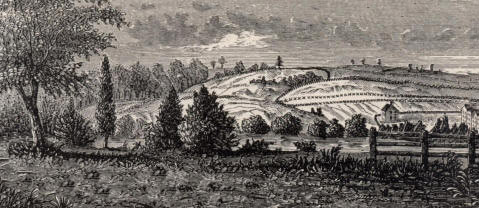
Chatterton’s Hill: Battle of White Plains on 28th October 1776 in the American Revolutionary War
British Regiments at the Battle of White Plains:
The Second Brigade comprising: 5th, 28th, 35th and 49th Regiments of Foot and the 16th Light Dragoons, Rahl’s Regiment of Hessians and other unidentified Hessian Regiments.
American Formations at the Battle of White Plains: Spencer’s Division (New England), Hazlet’s Delaware Regiment, McDougall’s 1st New York, Ritzema’s 3rd New York, Smallwood’s Maryland Regiment, Webb’s Connecticut Regiment, Brook’s New York militia and Graham’s Massachusetts militia.
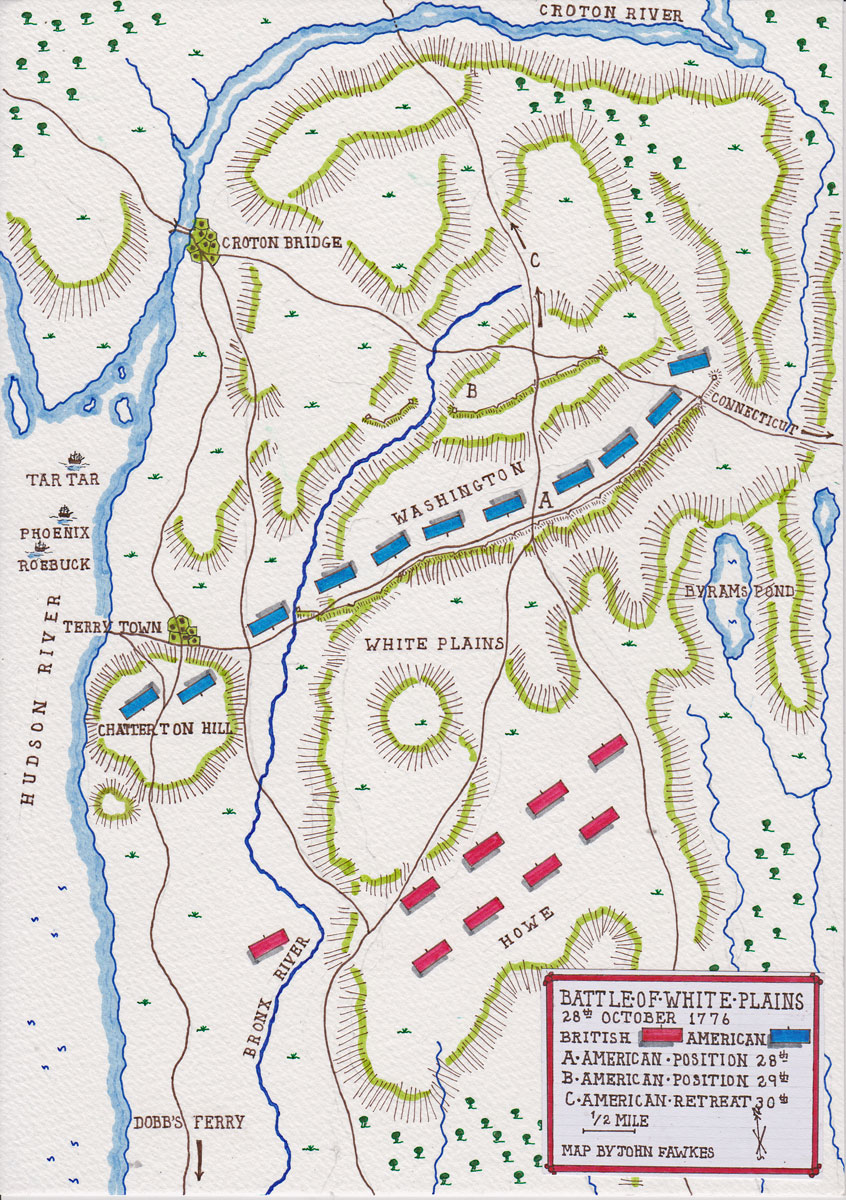
Map of the Battle of White Plains on 28th October 1776 in the American Revolutionary War: battle map by John Fawkes

British Light Dragoon officer: Battle of White Plains on 28th October 1776 in the American Revolutionary War
Account of the Battle of White Plains:
At the end of September 1776, General Washington’s army occupied the northern tip of Manhattan Island and the ground to the West of the Bronx River north of Kingsbridge. General Howe, from his positions on the rest of Manhattan Island, determined to outflank the Americans with a landing at Throg’s Neck to the east of the Bronx River.
The British landing on 12th October 1776 was held by Pennsylvania, New York and Massachusetts troops, forcing the British to re-embark in their boats and land further up river at Pell’s Point. Meanwhile, Washington withdrew his main army north to positions at White Plains on the east bank of the Bronx River, north of Yonkers. On the insistence of Congress a substantial garrison was left at Fort Washington on northern Manhattan Island. Howe and his British and German troops followed Washington via New Rochelle and up the Bronx River.
Washington fortified a position between the Bronx River and the Crotton River. On the far side of the Bronx was an isolated outpost on Chatterton’s Hill held by Colonel Spencer, Colonel McDougall and some 4,000 men, including two New England militia regiments under Colonel Rufus Putnam.
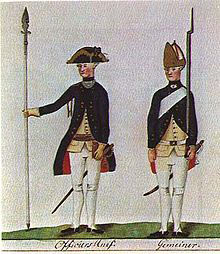
Hessian Fusilier Regiment von Knyphausen: Battle of White Plains on 28th October 1776 in the American Revolutionary War
Colonel Rahl, with two Hessian regiments, advanced on a small hill that lay unoccupied beyond Chatterton’s Hill on the extreme American right, while the British 2nd Brigade attacked the Americans on Chatterton’s Hill, supported by two further Hessian battalions. This attack pushed the Americans back, until the flanking threat from Rahl’s men caused the Americans to withdraw from the hill and retreat across the river to join Washington’s army. The British did not press this attack.
In the meantime, Howe called for reinforcements from Brigadier Lord Percy in Manhattan, to mount an attack on Washington’s main army as it withdrew to a position to the rear. For some reason, that remains unexplained, this attack was not mounted, and Washington and his army were left to pull back across the Crotton River.
Casualties at the Battle of White Plains: British casualties were 313 killed and wounded. The Americans lost 300 killed, wounded and captured. The American figures are speculative.
Follow-up to the Battle of White Plains: Howe was able to take advantage of Washington’s withdrawal with much of his army, to take Kingsbridge and capture Fort Washington. This was a considerable blow to the American cause and precipitated the headlong American retreat to the Delaware River.

American troops moving onto Chatterton’s Hill: Battle of White Plains on 28th October 1776 in the American Revolutionary War
Anecdotes from the Battle of While Plains:
- Washington Irving’s story ‘The Legend of Sleepy Hollow’ and the film ‘Sleepy Hollow’ centred on a Headless Hessian Horseman. It is believed the story was based on an incident in the Battle of White Plains when a Hessian soldier was decapitated by a cannon shot.
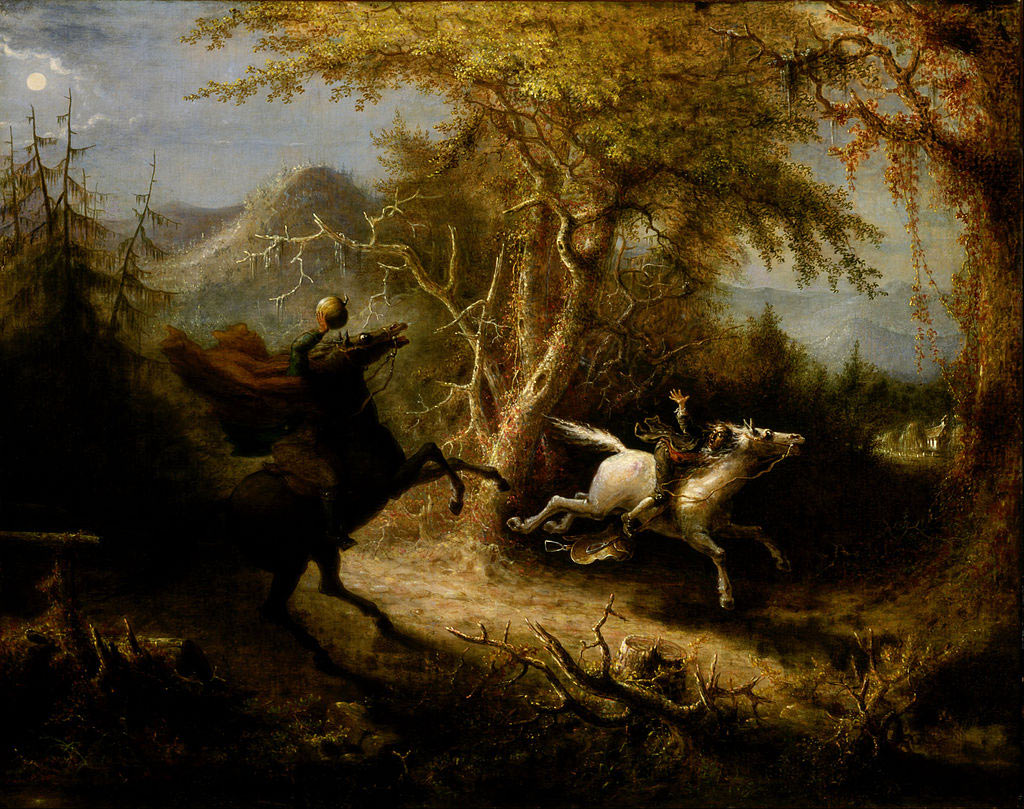
The Headless Horseman pursuing Ichabod Crane: Battle of White Plains on 28th October 1776 in the American Revolutionary War: picture by John Quidor
References for the Battle of White Plains:
History of the British Army by Sir John Fortescue
The War of the Revolution by Christopher Ward
The American Revolution by Brendan Morrissey
The previous battle of the American Revolutionary War is the Battle of Harlem Heights
The next battle of the American Revolutionary War is the Battle of Fort Washington
To the American Revolutionary War index